

Source: French to English Tester Published on: 2026-05-20
Source: The Conversation – in French– By Adrien Nonjon, Lecturer, Catholic Institute of Paris (ICP)
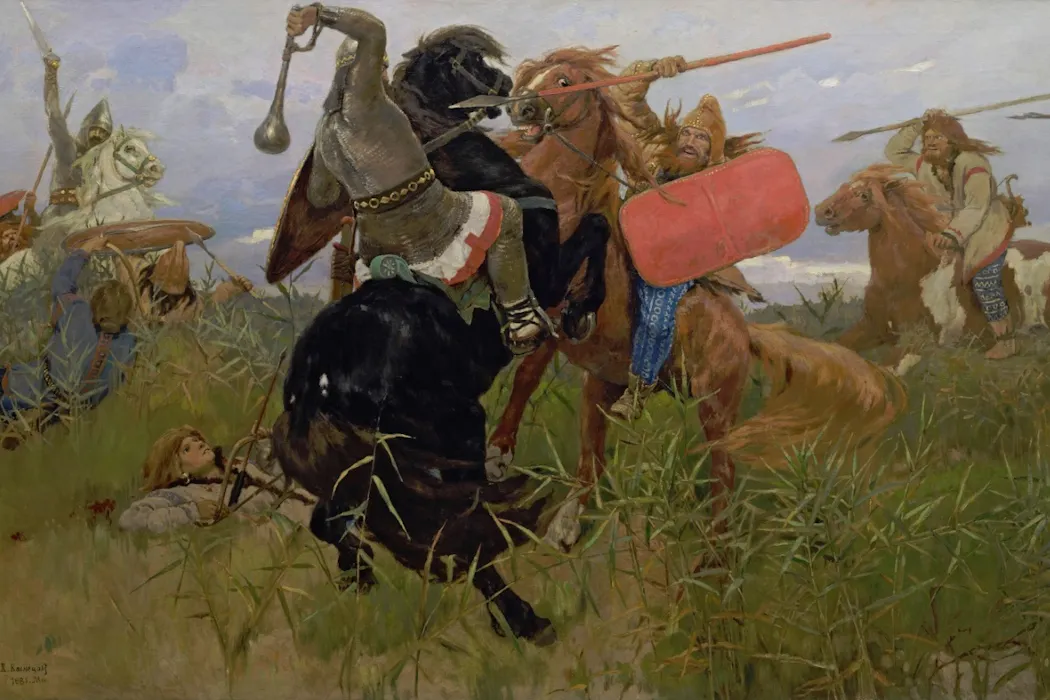
Since Russia’s invasion of Ukraine in 2022, the conflict has generally been analyzed through its geopolitical and military dimensions. But it also fits into a less visible battle: that of origin narratives. Mobilized by certain fringes of the Russian and Ukrainian far right, the Indo-European hypothesis feeds identity and esoteric imaginaries which, although marginal, help give a deeper — and sometimes mythological — meaning to the war.
The Indo-European hypothesis, as a political myth of origins, influences many far-right factions across Europe. Ideologists and fighters involved in the Russo-Ukrainian conflict use it, on both sides of the front line, to justify this war. According to them, it is a battle fortheUr-Homeland(German linguistic term literally meaning “original homeland” and designating the first home of an Indo-European proto-language, the Ukrainian plains being considered the cradle of theYamna culture(Final Neolithic: from 3600 to 2300 BCE). This period, according to certain archaeological, linguistic, and phylogenetic theories following the controversial work of the anthropologistMarija Gimbutas(1921-1994), would represent the point of emergence and diffusion of a supposed primitive Indo-European people.
Since February 2022 and the invasion of its territory by Russia, Ukraine has not only become the scene of an armed confrontation. Under the rubble of bombed cities and in the steppes marked by trenches, someillegal archaeological excavationsconducted by the Russian army testify to a war that is also being fought deep underground in order to extract from the past something that official history no longer seemed to provide.
Also to read:
How the war threatens Ukraine’s rich archaeological heritage
If Vladimir Putinlegitimatethe triggering and continuation of its “special military operation” by, among other things, the necessity for Russia to reintegrate into its national space the former territories of the Rus’ of Kiev, cradle of Eastern Slavic Orthodoxy, the recourse to the Indo-European hypothesis refers to an even deeper identity question, touching on the “ethno-racial” roots of the whole of Europe.
More than purely historical, this hypothesis has also been linked to metaphysical and cosmogonic considerations, sometimes borrowing the singular paths of esotericism and occultism. Of course, the current war cannot be explained solely by an analysis of these considerations, which may seem folkloric and marginal; but they feed powerful political imaginations.
Hyperborea and the Indo-European question
The Indo-European hypothesis was born in the 19th century from thecomparative grammar invented by the German linguist Franz Bopp, before being quickly integrated into the racialist and evolutionist perspectives of that period. It was then reappropriated by themovementsvölkisch, in Germany and Austria, then by National Socialism, which used it to “scientifically” demonstrate the superiority of the “race”aryenne.
From this first phase of existence, it could be mixed with esoteric and occult considerations, being associated in some places with specific theses, such as that of the existence of a“Primitive tradition” with Nordic and Hyperborean origins.
In the second half of the 20th century, theFrench New Right takes hold of itA – relying on the work in comparative mythology ofGeorges Dumézil – to affirm a specifically European ethnic and cultural unity. Currents such as theancient astronaut theoryby Robert Charroux (1909-1978), taken fromfantastic realism, were able to convey it under its esoteric and pseudo-archaeological aspects, contributing to its dissemination within political fringes.
However, the question of Indo-European origins cannot be reduced, in Russia as in Ukraine, to these Western theories alone. TheSlavophile movementthus laid as early as 1830 the first foundations of a reflection on Russian identity, as an organic civilization distinct from the rational and individualistic West, where Russia would be the guardian of an original spiritual truth, thesobornost, that is to say, an organic community of souls founded on orthodoxy.
Imperial Ukraine also sees the emergence of the question of origins. Figures such asMykhailo Hrushevsky(1866-1934) drew from mythology to nurture a living cultural identity. Then, during the interwar period, Ukraine saw various attempts to synthesize Ukrainian nationalism, Slavic neo-paganism, and references to Aryan origins, such as that ofVolodymyr Shaïan(1908-1974), founder ofthe Order of the Solar Knights. According to him, Ukraine would embody one of the last bastions of an authentic Aryan civilization, heir to Vedic wisdom – Hinduism being considered here as the last remnant of the Indo-European tradition – opposed to Western decadence and Christian influences.

San zav/Wikipedia,CC BY-NC-SA
The Soviet regime does not eliminate these currents. Encouraged by the Stalinist regime, archaeologists and prehistorians, such asBoris Rybakov(1908-2001), build a Russian-Soviet national archaeology which, without delving into the esotericism of Aryan origins, prepares the ground for later instrumentalizations by the neo-pagan movements of the 1990s.
In exile since 1920,Nikolai Troubetzkoy(1890-1938) mobilizes his expertise as a specialist in Indo-European languages to assert the Eurasian civilizational specificity, opposed to the “Romano-Germanic egocentrism” which he denounces as a form of ethnocentrism disguised as universalism. On the Ukrainian side, Shaïan and his discipleLev Sylenko(1921-2008) develop a “native” belief system making Ukraine “the ancient Oriana, cradle of the Aryans.”
At the same time, themyth ofBook of Veles – set of tablets supposedly engraved in the 9theThe century and tracing the history of the Slavic ancestors from their Aryan origin to the Rus’ of Kiev — is forged with the aim of attesting to the antiquity of Ukraine and its distinction from Russia.
Theperestroikathen the fall of the USSR in 1991 released these accumulated divergences. Thus, the nationalist, antisemitic, and mystical Russian movementMemories(“Memory”) constitutes the first organization to openly mobilize an imaginary of Slavic and Aryan origins mixed with Orthodox esotericism. This dissemination also occurs through other, more diffuse channels, of Russian and Ukrainian neo-pagan movements toward Hyperboreanism, carried among others byAleksandr Asov(born in 1964), pseudo-historical current that considers the mythological continent of “Hyperborea” as the homeland of an Arctic Slavic civilization, ancestor of all human civilizations.
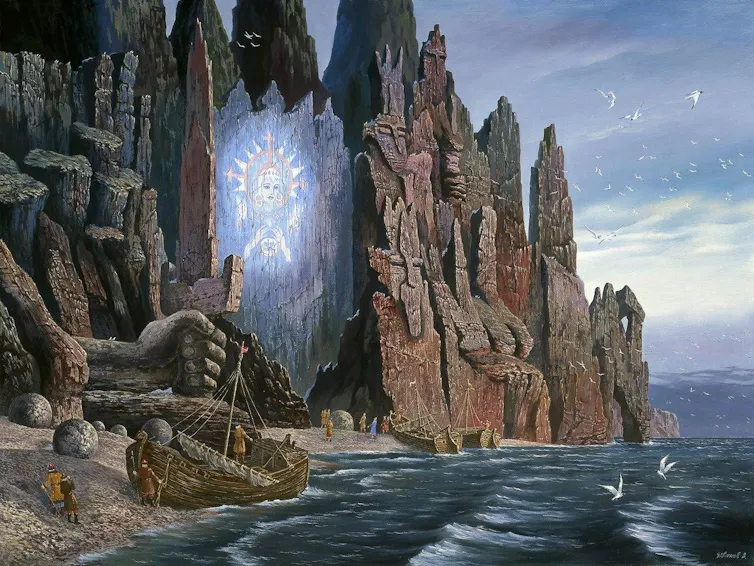
Vsevolod Ivanov/VK/Life.ru
The ultimate battle for the Ur-Heimat
In Russia,Alexander Dugin(born in 1962) built his political theory, which defends the necessity of building an empire extending from Brest to Vladivostok, relying notably on the Indo-European hypothesis. Drawing inspiration from authors like the SSHermann Wirth, the neo-fascistJulius Evolaand the esotericRené Guénon, he considers that the European peoples all originate from the same original homeland, “Arctogaïa” (his own version of the Hyperborean myth), and that from this would arise a “primordial tradition” uniting them all – the most enduring remnant of which today would be found within the rites ofthe Orthodox Church of the Old Believers.
He published it in 1993the Hyperborean Theory, a work that constitutes one of the esoteric foundations of his political project. For him, Western modernity, represented by the democratic ideal, social liberalism, and philosophical materialism, represents an existential risk and the utmost corruption of this “primordial tradition.” Modernity and progressivism would denature humanity while perverting the fundamental identities of European peoples.
From an eschatological perspective, and to avoid the “coming of the Antichrist” (whose seeds are, according to him, carried by liberalism), Douguine considers Russia, by its traditionalist anchoring, as theKathekon(the force that holds back, precisely, the Antichrist). Thus, according to him, the war in Ukraine is as much an identity necessity – bringing about the advent of Slavic peoples as preservers of the “primordial tradition” and as a condition for the emergence of the Eurasian Empire – as a metaphysical one –, because it contributes to the destruction of the “satanic” West. By reintegrating theOriginal HomelandUkrainian to the Motherland, Russia would thus secure a first decisive victory in its role ofKathekon, thereby starting a process of definitive return to theTradition, towards a new Golden Age.
Some Ukrainian far-right ideologues have constructed, on the same mythological foundations, a thesis that is exactly opposite. Where Dugin makes Russia theKathekonAryan against the dissolving West, these currents mobilize the sameOriginal Homeland, the same Hyperborean symbols, the same cosmology of origins, but with diametrically opposed conclusions.
According to them, Russia is not, contrary to what Douguine claims, the heir to the Nordic Indo-European tradition, but rather the product of a mixing with the Turkic-Mongol peoples of the eastern steppe, a mixing that would have definitively distanced it from the original Aryan heritage. This thesis has its roots in an ancient intellectual tradition, such as that ofFranciszek Duchinski(1816-1893), who stated in the 1860s that the Russians were not Slavs but Turanians — a group of Turkic and Finno-Ugric peoples — as well as in the works of the 19th-century Ukrainian anthropological school, notably those ofFedir Vovk(1847-1918).
It is on this historical and pseudo-scientific foundation that the contemporary radical Ukrainian ideologists close to parties and movements, such asUkrainian patriotwhereNational Social Assembly, built their inversion of the Douguinist schema. Russia is described there as an empire of the eastern steppe, heir to theGolden Horde, whose expansion to the west represents the same existential threat as the medieval Mongol invasions. By resisting, Ukraine is not only defending its national territory, it is defending the border of thePrimeval homelandAryan against its occupation by the Horde.
Translations of the myth
Far from being confined to these political and philosophical margins alone, these theories are part of a multitude of variations on the battlefield, whether ideological or military.

Wikimedia,CC BY
Indeed, one of the most troubling characteristics of the Russo-Ukrainian conflict is precisely the porosity of the discourses and their syncretisms. One can thus observe a shift even in the speeches of Vladimir Putin himself. The Russian president employs an argument of historical and ethnic priority which, without resorting to explicitly Aryan vocabulary, relies, through references to the Rus’, on the same fundamental logic of common origins and indivisible heritage.
This narrative operates exactly at the scale of medieval history what Douguine’s cosmology operates at the scale of Indo-European prehistory: it postulates an original unity betrayed by modernity, of which war is the violent and necessary restoration. The Russian Orthodox Church follows the same narrative pattern. Patriarch Kirill presented the war in Ukraine, from the very first weeks following the invasion, as a “holy war“against Western moral decay.
On the strictly military ground, the ideological imprint is visible in the composition, practices, and symbols of certain Russian and Ukrainian combat units, which constitute a privileged observatory of how esoteric imaginaries of origins translate into fighting motivations and warrior identities.The volunteer battalions that flocked to both sides of the front, starting from 2014, then en masse after February 2022, form an ideological spectrum of great diversity, but whose most radical fringes bear a troubling continuity with the imaginaries we have examined.
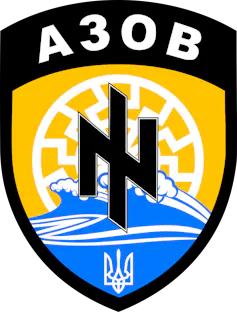
Wikimedia,CC BY
There are many thus,on the Ukrainian side, but alsoon the Russian side, fighters who openly display SS symbols, runic tattoos, and references to Aryan esotericism illustrating the presence of currents that see the conflict as a battle for the defense or reconquest of the Hyperborean homeland, of theOriginal homeland.
However, it is important not to overestimate the ideological coherence of these positions. In many cases, the stances of the radical right on the war in Ukraine have been determined less by reflection on the Indo-European hypothesis than by immediate political calculations, pre-existing geopolitical allegiances, funding, and material interests that have nothing metaphysical about them. They nevertheless remain a testimony to a prevailing crisis where metanarratives are reemerging.
This article was co-written with Cédric Lévêque, PhD in social anthropology, and Thibault Brice, master’s student in analytic philosophy (University of Geneva), co-founders of the journal Cosmos.

Adrien Nonjon does not work for, advise, hold shares in, or receive funds from any organization that could benefit from this article, and has declared no affiliations other than his research institution.
–ref. Ukraine as the “Ur-Heimat”: when the war becomes a battle for Indo-European origins –https://theconversation.com/ukraine-like-ur-heimat-when-war-becomes-a-battle-for-indo-european-origins-281940