

Source: French to English Tester Published on: 2026-05-20
Source: The Conversation – in French– By Pierre Firode, Associate Professor of Geography, member of the Mediations laboratory (Sorbonne University), Sorbonne University; University of Versailles Saint-Quentin-en-Yvelines (UVSQ) – University Paris-Saclay
Screenshot/X
The Islamic Republic of Iran no longer limits itself to classic asymmetric warfare based on the massive use of drones or blocking the maritime route it controls: it innovates especially through the massive use of AI in its propaganda and through a decentralized organization of its military and diplomatic power. This strategy allows the Iranian regime to sustainably resist U.S. pressure while exploiting the political and media vulnerabilities of Western democracies.
The astonishing resilience of the Islamic Republic of Iran (IRI) is often presented as the result of an art of asymmetric warfare that the Tehran regime deploys with formidable efficiency. In the current context, time is working in its favor: the economic cost linked to the rise in oil prices and the political damage caused to the Trump administration are increasing week by week,completely undermining popular support for the war in the United States, including within the MAGA sphere.
To endure over time, Iran relies on an arsenal of asymmetric weapons, of which the Shahed drone and missile boat patrols have become the emblems. Mass-produced, these weapons allow it to maintain a state of permanent insecurity over maritime traffic in the Strait of Hormuz as well as on the territory of the Gulf monarchies. This hostage-taking of the global economy and neighboring states, including those that declare their neutrality, such as Oman or Qatar, could moreover become the new deterrent weapon of a mullah regime deprived of nuclear arms.
Nevertheless, this approach, widely covered in the press, does not point out what, in the Iranian strategy, constitutes a true revolution: the massive use of drones, the long-term strategy, as well as the disruption of international maritime flows are not new and could easily have been anticipated, given the attacks carried out by the Houthis in the Red Sea in recent years or the massive use of low-cost drones in an asymmetric context, already observed in thewar against ISISor toGaza(or in more conventional conflicts like inUkraine).
Analyzing this asymmetric arsenal in detail is an obvious necessity, but it overlooks the real revolution that is the use by Iran of much more recent tools, such as AI, or the establishment of adefense in “mosaic”, decentralized to an unprecedented level. Beyond the conventional weapons of the weak in asymmetric contexts, what are the real innovative strategic tools used by Iran?
AI, a new weapon in the service of an informational guerrilla warfare
The idea that the outcome of an asymmetric war is decided more in the informational sphere than strictly on the military battlefield is not new: it has moreover been the subject of active reflection by Al Qaeda theorists such as Ayman Al-Zawahiri. Where the regime of the mullahs innovates is not so much in the objectives of the informational war, that is, the mobilization of public opinion against the American war effort, but in the use of new tools to develop its propaganda.
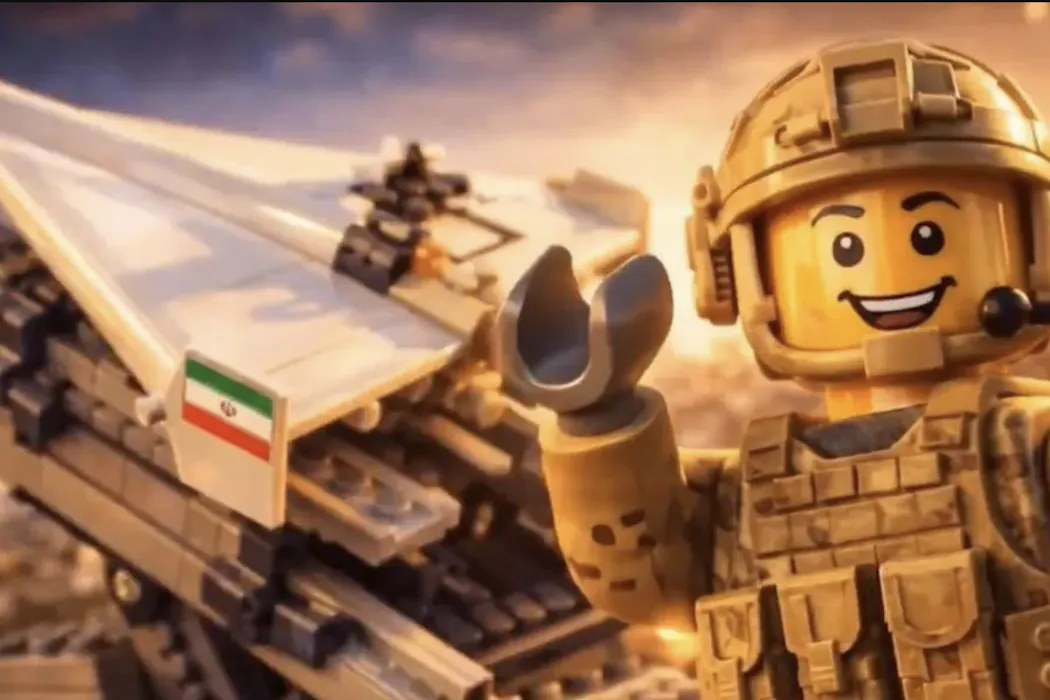
In this regard, it is significant to focus on the increasing use by the Islamic Republic of Iran (IRI) of AI in the media offensive it is launching targeting Western public opinions. AI allows for the mass production of propaganda videos: economical, easy to produce in large numbers, Iranian propaganda videos,like those that involve the world of Lego, flood the web. What is most striking about these videos made for the Western audience is certainly their ability to saturate the media space and to spread on social networks while escaping any form of control from the platforms on which they are disseminated. Due to their playful format resembling a cartoon, these videos evade censorship present on YouTube or Instagram, which prohibit content with violent character or showing the reality of war.
Also to read:
AI, Lego, and rap: Iran’s new weapons against Trump and Netanyahu
Here, Tehran is developing a strategy contrary tothat of terrorist groups such as Hamas or Al-Qaeda. They choose to post videos centered on the experience of violence, which show the war in a raw way, in order to give media resonance to their fight, even if it means abandoning platforms that censor this type of content like YouTube or Instagram, in favor of networks where censorship is much less prevalent, like X or Telegram.
As a result, jihadist groups have a certain freedom, but limit the audience of their propaganda to a niche of users who follow X accounts or Telegram channels that publish violent content. In contrast, Tehran seeks to broaden the audience of its propaganda videos by massively investing in platforms where censorship is active, such as Instagram or YouTube, with content designed to go viral.
Even though accounts associated with the IRGC, such as Explosive Media, are gradually being blocked by Instagram and YouTube, Iranian propaganda videos, because they present themselves as cartoons where the violence is only implied, cross the initial barrier of censorship and are then widely shared by internet users around the world, making any attempt to censor them futile. Tehran thus implements the principles of saturating enemy defenses and threat dissemination dear to asymmetric strategies, but applies them to the digital sphere.
To do this, Tehran uses AI as a guerrilla tool that saturates the informational defenses of democracies and capitalizes on the discrediting of traditional media in Western societies that are increasingly inclined to get their information from social networks rather than from classical media.
The principle of mosaic defense pushed to its paroxysm
In addition to invading the enemy’s informational sphere, Tehran also proves capable, thanks to its new art of asymmetric warfare, of better resisting the Americano-Israeli offensive internally. To do this, the regime implements a strategy of decentralizing power to maintain the war effort of the various provinces of Iran even when high-ranking regime personalities are eliminated.
This strategy is not new and recalls that of terrorist groups that favor a fairly autonomous cell organization like the emirates of the Islamic State in Syria and Iraq, which had their own headquarters and reserves of fighters, weapons, and associated ammunition. What characterizes the Iranians’ new art of asymmetric warfare is not so much this effort to decentralize military command but rather the extension of this principle to the diplomatic sphere.
More than a classic dispersion of military capabilities, Tehran has apparently delegated dialogue—and war—with regional powers to local leaders from the Pasdaran, endowed with genuine autonomy as evidenced by the strikes carried out against countries that are nevertheless Tehran’s partners, such asOman, by means of drones launched from the provinces of Bushehr and Hormozgan.
It is legitimate to hypothesize that these attacks resemble local initiatives, so much do they oppose the diplomatic efforts to bring Tehran closer to Oman and the necessity for Iran to have regional diplomatic partners and, above all, outlets to place the revenues generated by the sale of oil.
The attack on a ship belonging to a Korean shipowner, the HMM Namu, on May 4, 2026, could also be likened to a local initiative since the interest of the Islamic Republic is much more about extorting passage through the strait rather than purely and simply preventing it. The attack on ships therefore probably stems from local initiatives illustrating a strategy of complete dissemination of functions traditionally monopolized by the central state such as diplomacy.
This method could stem from a conscious choice by the leaders of the Islamic Republic of Iran to undermine the American strategy aimed at pressuring the Iranian state through the blockade of its oil exports. For Washington’s strategy to be effective, there must be an Iranian counterpart to be forced to negotiate through economic strangulation. However, this strategy loses all efficiency if each Iranian province pursues a policy decided at the local level independently of the choices made by the state leaders, such as the President of the Republic Massoud Pezeshkian or the President of the Assembly Mohamed Ghalibaf.
In this regard, it is interesting to highlight the interventions in which Donald Trump notes the difficulty of negotiating and obtaining a dealwith a country whose real leaders are difficult to identifyand where the level at which decisions are made becomes increasingly obscure. Whether it is a conscious strategy on the part of the Islamic Republic of Iran or the result of the elimination of its leaders, this Iranian dispersal of diplomatic initiative renders Trump’s approach obsolete, whose negotiation with Iran then takes the form of a sterile monologue forcing the American president to escalate to avoid losing face in front of his public.
Fold without breaking
Thus, if Tehran has indeed renewed, or even revolutionized, asymmetric warfare, it is not so much through the massive use of drones or the desire to prolong a war for which democracies like the United States are unprepared, but rather through the scale at which the decisions to use these weapons are made. More than a vertical decision emanating from Tehran, the sporadic drone strikes or attacks on ships passing through the Strait of Hormuz reveal that the Pasdaran have decision-making autonomy in Iranian provinces that is not only military and strategic but also diplomatic.
In this context, it seems futile to want to force Iran to “capitulate” as Trump claims. Capable of bending without breaking, the Iranian regime has also revolutionized the means of spreading its propaganda by massively using AI and investing in new platforms, adapting the art of guerrilla warfare to the digital and informational fields. Here, the Islamic Republic of Iran benefits from an underlying trend in Western societies: getting information from networks at the expense of traditional media,trend reinforced by Trumpism. Once again, the Islamic Republic uses against the Trump administration rhetoric that the latter itself popularized, illustrating how the internal weakening of American democratic institutions by the current occupant of the White House favors its worst enemies on the international stage.

Pierre Firode does not work for, advise, hold shares in, or receive funds from any organization that could benefit from this article, and has declared no other affiliation than his research organization.
–ref. AI and decentralization of command centers: the true revolutions of war in Iran –https://theconversation.com/ai-and-decentralization-of-command-centers-the-true-revolutions-of-war-in-iran-282761