

Source: MIL-OSI-Submissions-English
Source: The Conversation – France – By Samuel Challéat, Chercheur, Centre national de la recherche scientifique (CNRS)
As part-night lighting (i.e., turning off streetlights in the middle of the night) becomes more widespread among local authorities, three studies focusing, respectively, on robins, toads and bats show that, often, turning off the lights for a few hours is not enough to restore natural night. In terms of biodiversity, the challenge is not just about switching off the lights, but knowing when and where to do so.
In recent years, switching off street lighting in the middle of the night has turned out to be a no-brainer for several challenges: reducing energy bills, demonstrating a commitment to energy efficiency, and limiting light pollution and its effects on ecosystems.
From a biodiversity perspective, the best solution would be to have no lighting at all.
But this option clashes with other legitimate uses of night-time spaces: our own! This leaves one question: is switching off the lights for a few hours in the middle of the night really enough to reduce the impact of light on biodiversity? Not necessarily: its effects on organisms depend on the context – location, large-scale light landscape, weather conditions – and the species concerned.
A widespread measure whose biological effects remain poorly understood
Not all species actually use night-time in the same way. The early evening, the middle of the night and the hours leading up to dawn are often associated with different behaviours: foraging, movement, returning to roost, falling asleep and waking up, communication… In this context, part-night lighting may limit certain effects of light pollution on biodiversity… or miss the mark entirely if it doesn’t coincide with species’ peak activity times.
Another important point: switching off lights locally does not necessarily mean returning to total darkness. In towns and cities, nearby lighting – streetlights on adjacent streets, shop signs, shop windows or private lighting – as well as light scattered by clouds often maintain residual brightness. And this effect is not limited to urban zones: in rural areas too, the light halo from towns and cities can remain visible for several dozen kilometres (approx. 15 miles). For the species most sensitive to light, the difference between periods when lights are on and off may, therefore, be minimal, even when public lighting is switched off locally. A local council’s switch-off schedule is therefore not sufficient, on its own, to describe the actual lighting conditions to which animals are exposed.
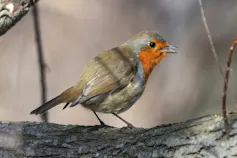
The European robin, commonly found in cities: switching off the lights in the middle of the night isn’t enough
Giles Laurent, CC BY
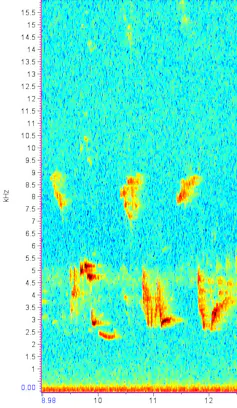
This is what we observe in the European robin. For this diurnal bird, part-night lighting is not sufficient, in an urban context, for restoring activity patterns comparable to those observed in unlit areas. Even when streetlights are switched off between 11:00 pm and 6:00 am, the birds tend to sing earlier in the morning and later in the evening than in truly dark areas.
Fourni par l’auteur
To test this effect in the Nantes metropolitan area (Loire-Atlantique department) in France, we compared three types of site: unlit sites, sites lit up all night, and sites where street lighting is switched off for part of the night.
We used a simple indicator: the European robin’s song. By recording the soundscape over several days, we can reconstruct the species’ singing patterns across the entire day-night cycle and see how they vary according to light conditions.
The result is clear: sites where lighting is cut off in the middle of the night often look more like sites lit all night than unlit ones. The gap appears mainly at key moments for this species, at dawn and dusk – respectively around 40 minutes before sunrise and 20 minutes after sunset – which correspond to its peak vocal activity.
The familiar bird song of robins, as well as those of the Eurasian wren, chaffinches and blackcaps.
Laurent Godet, Fourni par l’auteur737 ko (download)