

Source: French to English Tester Published on: 2026-05-18
Source: The Conversation – in French– By Nicolas Brun, PhD student, Sorbonne Paris North University
While gambling is now just a click away, traditional sales points, in local shops, remain strategic showcases for operators. They are also important meeting places for the players themselves. Because playing does not stop at the bet or scratch-off game but takes place within venues and a general sociability. Explanations.
The Lotto is 50 years old! First marketed in May 1976 by the National Lottery (today FDJ United), the Lottery at the time marked the beginning of the revival for lottery games in France.
Half a century later, at a time of increasing digitization of practices in society,27% of the world’s gross gaming productand18.5% of that achieved in Franceare done online. It is now possible to play in a few seconds, from your phone, without any particular constraint of place or time.
In this context, how can the persistence of physical points of sale be explained in the organization of the gambling market in France? Why, in the digital age, does FDJ United continue to have the largest commercial network in France, with nearly 29,000 partner stores?
An advertising visibility lever
The physical network of the French national lottery (FDJ) initially has a considerable economic weight in the group’s results, since, in 2025, 93% of the gross gaming revenue generated in France (calculation based on data presented in FDJ United’s financial documents), still passes through these points of sale. Despite a less dense network (about14,000 points of sale), the observation is similar for the horse race betting operator, the Pari Mutuel Urbain (PMU).
But this economic weight cannot be understood independently of the location strategies implemented by operators and the choices of the public authorities. Indeed, in a market as regulated as the gambling market, these“are supposed to exist only where they are expressly permitted”.
The creation and maintenance of a network of points of sale do not thus result from a simple logic of uniform commercial distribution: it is constructed in a targeted manner, depending often on the neighborhoodspopularanddisadvantaged(Figure 1), population flows and areas of high traffic.
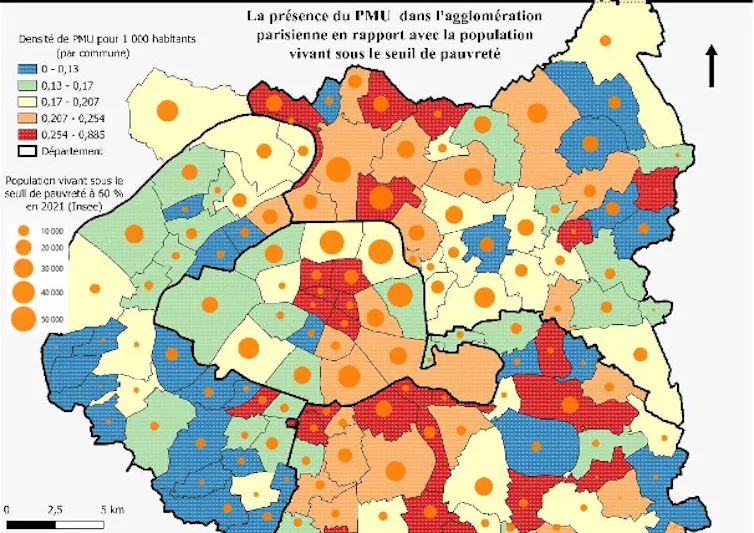
Nicolas Brun, 2022,Provided by the author
In this perspective, the choice of locations isnever without consequences. This is a genuine supply policy, which aims to maximize the opportunities for contact between the targeted audiences and the sales outlets of gaming products.
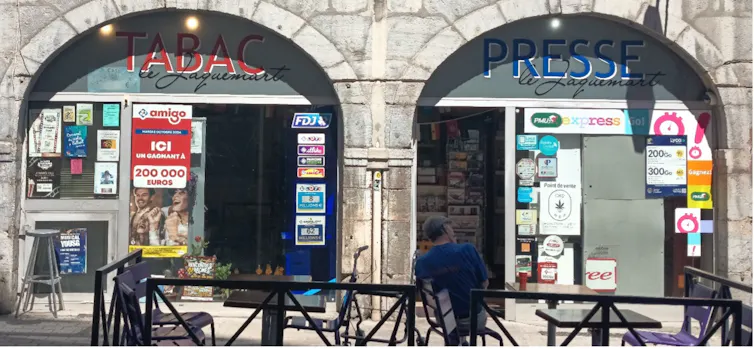
Nicolas Brun, Besançon (Doubs), May 8, 2026,Provided by the author
Points of sale also serve as showcases and reminders of what can be won by playing (Image 1). Mainly located in local businesses (bars-PMU, tobacco-press shops), game operators seek to be close to people and their habits. At the same time, the visibility of the game isincreasingly markedin the streets andpublic transportationThrough theadvertising campaigns(Image 2).
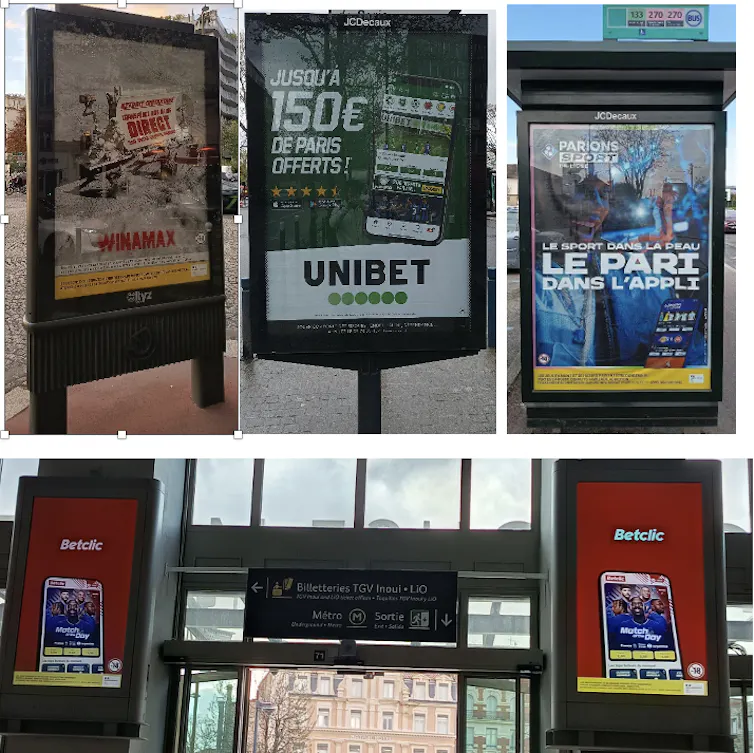
Nicolas Brun, 2025,Provided by the author
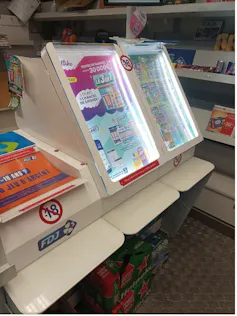
Moreover, the multi-activity nature of gaming venues in France encourages the arrival of a varied clientele, who then find themselves heavily solicited by messages and incentives to play. Seeing the amount of the next jackpot and the winnings made at this point of sale, passing by the display of scratch cards (Image 3), having to add a Lotto slip in order to pay for cigarettes with a bank card are all situations that facilitate playing and encourage consumption.
Play as a means of socializing
To try to understand the role of sales outlets in gambling practice, however, one must go beyond the reductive interpretation that consists in thinking that one only plays with the very hypothetical hope of winning the “jackpot.”
Certainly, the hope of a financial gain remains themain driver of the players. The fantasy of the jackpot, carefully maintained by the“Big Gambling”, allows one to dream of a better life. But this promise, which is only exceptionally fulfilled, cannot alone explain the persistence of the practices, especially in physical locations.
Nicolas Brun, Aubervilliers (Seine-Saint-Denis), May 20, 2022,Provided by the author
Indeed, playing,“It is above all a way of dealing with existence”. A way to avoid“ordinary time”, to maintain a possible relationship and to look beyond the everyday.
Numerous studies in the humanities and social sciences also show us that play spaces are alsosocial spacesin which somecommunitiesare formed and meet (turfists,friends,colleagues…). Of course, this is particularly true for PMU enthusiasts who, in practice, favor staying inside the gaming areas. But this does not mean that fans of lotteries, sports betting, or scratch cards escape this socialization within the points of sale.
We play while going to buy cigarettes, a newspaper, taking a coffee break, or leaving work. Playing is not necessarily central, but it integrates into daily practices involving micro-interactions. Shops know how to skillfully coordinate these routines.
A materiality that matters
One does not just play a game: one plays somewhere… and (for the moment) thissomewhereis still generally a sales outlet for the FDJ or the PMU.The gaming experience is inherent to the placewhere it takes place.
The atmosphere of the business, the posters, the screens, the discussions or the visitation habits fully contribute to the practice. The interior space of the points of sale thus constitutes atriggering mechanism, understood here as a set of material, spatial, and social arrangements that help guide behaviors and practices. In these spaces, nothing is left to chance, from the placement of the scratch ticket display, always positioned to be visible from the store entrance, to themicro-spacesstructured around each experience according to its preferred games (Figure 2).

Nicolas Brun, 2023,Provided by the author
This materiality of place and play matters. It thus introduces a form of disjunction. In these everyday spaces, the practice of play opens a parenthesis, the time of play briefly suspends the ordinary course of things. The mental space of play, a concept advanced by Winnicott,“contributes to building a temporality”specific to the game and its practices in specific places created for that purpose. In this sense, play spaces often function asheterotopiasÂ: spaces apart within daily life, where ordinary temporalities are momentarily suspended and where a form of collective illusion is constructed, that of being, facing chance,all equal in the possibility of success.
This suspension of time is moreover explicitly invoked in the communication strategies of the operators themselves. In a recentadvertising campaignfrom FDJ United for its brand,Betting Sport at point of sale, the gaming operator stages Éric Cantona in the role of a shopkeeper. In one of these advertising clips, the former football player and actor seeks physical contact with a bettor by shaking his hand for long seconds, which seem suspended out of time. This sequence focuses less on the result of the bet than on the intensity of the moment experienced in the gaming venue itself. The socialized space of the game appears here as a place that briefly alters the ordinary relationship with time.
When space invites play
The points of sale are not merely distribution outlets for scratch tickets or Lotto slips. They help organize the very conditions of the practice, by placing the game in familiar and sometimesfantasized, inside routines and ordinary social interactions, which foster theperpetuity of the hope of a significant gain.
Moreover, their placement within the urban space does not follow a neutral logic of proximity. Indeed, it is a strategy orchestrated by the gaming operators, based on thetargeting a part of the population, the capture of individual flows and the multiplication of solicitations to games (advertising pressure, visibility in the street…). The points of sale thus function as permanent display supports for the game.
The establishment of gaming areas in businesses visited for multiple reasons, where consumption (of alcohol), socializing, and movement overlap, also promotes gambling.trivializes the uses.
It is this organized production of visibility and accessibility of the game that helps understand the persistence of points of sale in a sector that is nonetheless increasingly digitalized.

Nicolas Brun received funding from the Scientific Interest Group Game and Societies.
–ref. Gambling: why people keep betting in bars and tobacco shops despite the rise of online gaming –https://theconversation.com/gambling-why-do-we-keep-betting-in-bars-and-tobacco-shops-despite-the-rise-of-online-gambling-281372