

Source: French to English Tester Published on: 2026-05-16
Source: The Conversation – in French– By Nicolas Gentis, Doctor in Paleobotany, National Museum of Natural History (MNHN)
The Dipterocarpaceae are a family of iconic trees of Southeast Asia that dominate the canopies and often serve as refuge for orangutans. Their origin had long been mysterious, until the in-depth study of fossils, combined with plate tectonics and genetic data, revealed their African origin. But then how could these trees have arrived in Asia?
The forests of Southeast Asia are among the richest ecosystems on the planet: covering barely 3% of the land area, they host more than 20% of known plant species, a large portion of which is endemic, that is, found nowhere else. Among their most spectacular inhabitants are the Dipterocarpaceae, a family of tropical trees with winged fruits (hence their name, from the Greekof“two”, pteron “wing” andkarpós“fruit”) which can reachnearly 100 metersin height, the equivalent of a 30-story building.
These giants are distinguished by their characteristic architecture with tiered branches shaped like cauliflower, and they dominate up to 80% of the canopy. Some individuals avoid any contact with the branches of their neighbors, a phenomenon called “crown shyness.”
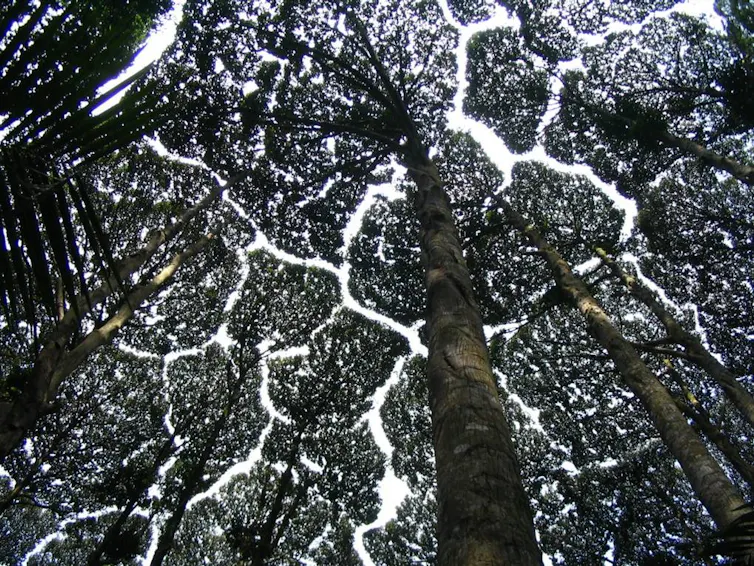
Patrice78500,CC BY
Beyond their impressive appearance, they play a major ecological role: they structure the forest and determine the existence of many other species, by providing, for example, shelter for the emblematic orangutans or an abundant food source for insects with their fruits.
But one of the most surprising aspects undoubtedly lies in their origin: these emblematic trees of Southeast Asia actually come from Africa. So, how can the presence of African groups on another continent be explained?
At first glance, nothing destined the Dipterocarpaceae for such a journey: their seeds must germinate quickly and any maritime excursion is to be avoided, salt water being fatal to the embryo.
To understand their history, it is therefore necessary to change scale: to leave that of space and enter that of time, and go back several tens of millions of years.
How do we trace the history of plant groups?
That’s what I try to dobiogeography, that is the discipline that studies the distribution of living beings in space and over time. To reconstruct the evolutionary history of a group, scientists cross-reference several sources of information.
The kinship relationships between species, called phylogenies, are established based on genetic data and morphological characteristics (mainly flowers and fruits). From phylogenies, it is possible to formulate hypotheses about the areas of origin of organisms.
These are then compared to the fossil record, that is to say the collection of known and recorded fossils, which provides direct evidence of the past presence of these organisms. The fossils used can be very diverse: petrified wood, leaves, fruits, or even pollen grains. The latter are particularly valuable because they are well preserved in sediments. The fossils are dated, notably byradiometric methodsand identified by relying on imaging tools ranging from conventional microscopy toX-ray tomography, allowing the observation of fine anatomical structures.
Finally, account must be taken of theplate tectonicsA: Over geological timescales, the continents have shifted, so the geographic coordinates of a fossil do not necessarily correspond to its original location at the time the organism lived. It is by combining all this information that we can reconstruct the distribution of plants at any point in history and thus track their evolution.
Fossils are the best empirical evidence
In the case of the Dipterocarpaceae, the oldest known fossils come from Africa: these arepollen grains dated to the late Cretaceous(between -72 and -66 million years), discovered in 2022 in present-day South Sudan. However, in the same period and at the beginning of the following era, the Cenozoic, no Dipterocarpaceae fossils are recorded in Asia.
This observation contrasts with the current distribution of the family: about 500 species in Southeast Asia, compared to only about twenty in Africa and just one in South America. For a long time, this finding suggested an Asian origin, but this hypothesis poorly explained the family’s presence on other continents and remained contested.
It is really only over the past thirty years, driven by advances in genetic analyses and the accumulation of fossil evidence, that the alternative hypothesis of an African origin has taken hold. Or more precisely, of an origin on theGondwana, an ancient supercontinent of the southern hemisphere that notably included Africa, South America, India, Antarctica, and Australia over 160 million years ago and which later fragmented.
The great crossing of a drifting India
“I cannot carry it for you, but I can carry you!” said the hobbit Sam Gamgee about the One Ring, to his friend Frodo, who was very weakened, in The Lord of the Rings.
Similarly, the Dipterocarpaceae could not have crossed the largest oceanic expanses on their own, but were transported by the continent carrying them. During the fragmentation of Gondwana, India separated from Africa during the Cretaceous and began an ascent northward through the Neo-Tethys, an ocean that no longer exists today.
It first encountered part of Myanmar, then Asia around 50 million years ago, leading to the formation of the Himalayas. The Dipterocarpaceae were thus able to move from Africa to India when the two continental masses were still close and located near the equator, then from India to Southeast Asia approaching the final collision. This scenario was introduced as early as the 1950s but has been considerably refined over the past 20 years through numerous geological and paleontological studies dealing with the India-Asia collision. It has the merit of accounting for both fossil data and the current distribution of species.

Provided by the author
A success story for some
The history of the family is then a textbook case in biogeography: although originally from Africa, the Dipterocarpaceae are mainlydiversified on the Indian subcontinentduring its crossing, then after the collision. They thensuccessfully colonized Southeast Asia, in the same way as other trees of Gondwanan origin such as certain palms, the families of persimmons, durians, or figs.
This success of the Dipterocarpaceae is probably due to several factors: prolific reproduction where the trees produce massive quantities of fruit synchronously, competitive growth that allows them to quickly dominate the canopy, as well as a symbiotic association withmycorrhizal fungi.
The end of the journey for others
However, not all plant lineages that followed similar trajectories experienced the same success. The “Indo-Myanmar” crossing sometimes represents a dead end. Somefossil woods discovered in Myanmar, dated from -45 to -30 million years ago, attest to the ancient presence of other groups of Gondwanan origin, such as close relatives ofEucalyptusor trees of the genusCola, which gave its name to the famous drink.
However, none of these trees seem to have succeeded in colonizing Southeast Asia: they have locally disappeared from the region, a phenomenon called extirpation, probably as a result of drastic climatic changes that occurred in the Miocene, between -23 and -5 million years ago.

Fossil and wood: Nicolas Gentis. Fruit: Bob Walker (modified), Provided by the author
The main points are there, but the details of the story remain in the shadows
If today we have been able to lift certain mysteries, delving into the past is a long and meticulous undertaking, and many uncertainties still remain. The reconstruction of the precise trajectories and temporalities of dispersals, the rhythms of diversification, and interactions with climate changes remain major challenges. Other exchanges of flora, notably between Australia and Asia, so-calledSunda-Sahul, have also shaped these forests. There are therefore still many clues to find in order to understand why some groups have persisted in Asia while others have not.
Interestingly, the animals seem to have followed different trajectories: in many cases, exchanges mostly took place from Eurasia to other continents. Thus, several groups of mammals, such as the ancestors of rhinoceroses, giraffes, zebras, felines, or numerous primates, colonized Africa from Eurasia; only the lineage of elephants is of African origin.
In Europe, a major event called the “Great Break” that occurred about 34 million years ago corresponds to a major renewal of the fauna linked tothe arrival of Asian species. Almost all primates disappear, as well as a large number of endemic mammals, while the arrival of rhinoceroses, close relatives of hippos, rodents such as hamsters or beavers, and small carnivores like the hedgehog is observed.
Understanding these past distributions is not only a matter of scientific curiosity: it allows us to identify the factors that promote or limit the long-term success of species. In the context of rapid climate change, this knowledge is valuable for anticipating the response of ecosystems and guiding conservation strategies.
In the cases of Dipterocarpaceae, more than65% of the speciesare today threatened by human activities, notably by deforestation for the exploitation of their wood or the planting of oil palms. The preservation of these trees thus ensures the preservation of all living beings that depend on them.

Nicolas Gentis does not work for, does not advise, does not hold shares in, does not receive funds from any organization that could benefit from this article, and has declared no other affiliation other than his research institution.
–ref. How African trees conquered the forests of Southeast Asia –https://theconversation.com/how-african-trees-conquered-the-forests-of-southeast-asia-282205