

Source: The Conversation – in French– By Annie Persons, Lecturer in Literature, University of Virginia
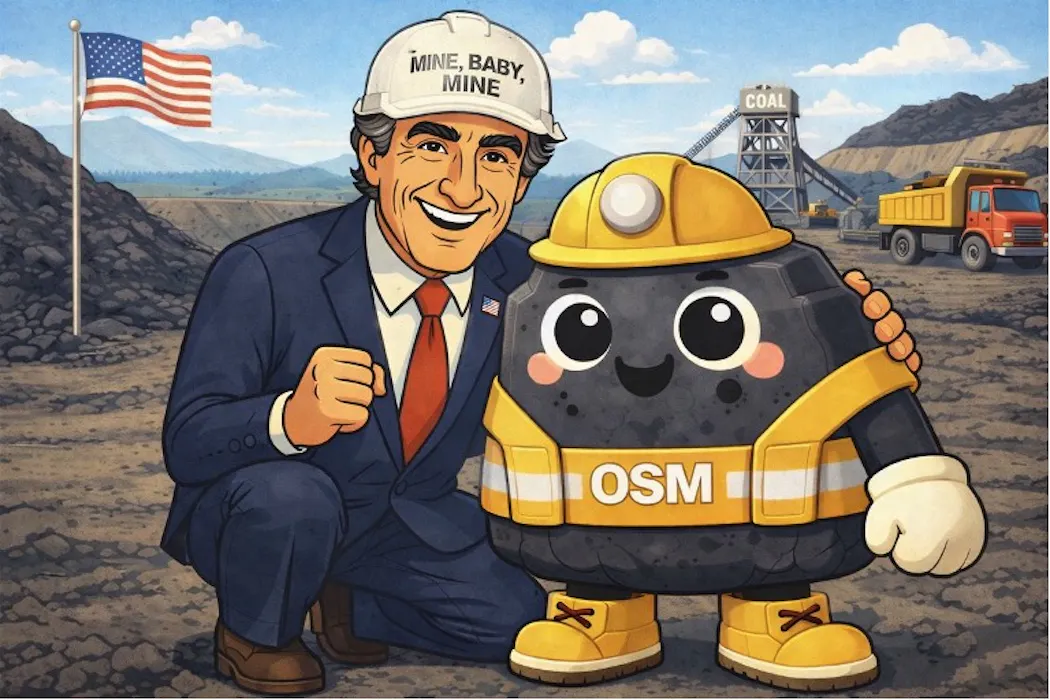
Interior Secretary Doug Burgam/X
Why is coal so often represented as “clean,” “beautiful,” or even “cute”? From 19th-century advertising to the social networks of the Trump administration, the history of this communication reveals a long effort to trivialize the dangers of coal.
If you follow the Trump administration’s posts on social media, you may have noticed its new mascot: a piece of coal in cartoon form, with big eyes and features reminiscent of a baby. Named “Coalie,” the character hastriggered a wave of criticismalmost immediately after its presentation by Secretary of the Interior Doug Burgum for the Office of Surface Mining and Reclamation Enforcement at the beginning of the year 2026.
The design of Coalieis inspired by the Japanese kawaii style, a termmeaning “cute” or “adorable”. This mascot is part of the recent efforts by the White House to present coal as something harmless, despite thewell-documented effectsof the extraction and combustion of this fossil energy on the environment and human health.
As a specialist in American literature and culture, Iworks on the media representations of coal, since the 19th century, when this resource became the main source of energy in the United States. The use of coal continued to grow until the early 2000s, before other energy sources became less expensive and its harmful effects on health and the environment became unacceptable to a growing segment of the public.
If “Coalie” is a novelty, the logic underlying it is not. For centuries, coal promoters have strived to present this resource as harmless — but also“clean” and “beautiful”, to quote President Donald Trump.
“A pleasant warmth”
Humans living in contact with burned coal have complained about it for as long as they have used it. Thus, in 1578, Queen Elizabeth I already said she was “deeply discomforted and irritated by [its] taste and smoke” in the air. In 1661, the treatyFumifugiumJohn Evelyn described for his part the harmful effects of coal on respiratory health.

University of California, San Diego Libraries/Wikimedia
The English settlers were notably attracted to North America because ofthe abundance of its wood resources, which constituted an alternative to coal that had become extremely expensive in England due to deforestation.
But in the 19th century,the price of wood also increased in the United States. When, in the 1820s,the discovery of the rich anthracite deposits of Pennsylvaniaspread, the city dwellers welcomed this new source of cheaper energy with enthusiasm.
Besides its lower price, anthracite has become attractive because of its high carbon content and low sulfur content, which produce less visible smoke when burning. Inan enthusiastic letter published in 1815in theAmerican Daily Advertiser, a reader was describing this form of coal — reflecting someincreasingly widespread opinions— providing “a very regular and pleasant warmth.”
“A healthy house”
The spread of anthracite also increased the acceptance of a more smoky bituminous coal, but cheaper. To help households, domestic manuals intended formain users of coal, women,were trying to imagine solutions to limit the smoke. In 1869, Harriet Beecher Stowe, best known as the author ofUncle Tom’s Cabin, and his sister Catharine Beecher thus publish one of the many 19th-century texts recognizing the“harmful effects” of coal smoke, while explaining how to create “a healthy home” in their home manualAmerican Woman’s Home.
Consumers also proposed temporary solutions to preserve indoor air quality despite the use of coal, by sending their tips to household manuals, magazines, and newspapers, which then published them.

Nineteenth Century Newspapers
At the same time, as the century progressed, coal companies and coal stove manufacturers began to claim that burning coal was good for health, capable not only of improving indoor air but also of beautifying homes. An advertisement published in a newspaper in 1892 thus claimed that stoves were “necessary to heat, brighten, and beautify the home while preserving its health.”
“To keep the children clean and full of life…”
In the 20th century, advertisers multiplied even more colorful arguments about the supposed benefits of coal. Ina magazine advertisement, a mother and her child show a stove crackling fueled by the company’s coal, described as “unequaled in terms of purity, cleanliness, and combustion quality”.

Madison Historical,CC BY-NC-SA
For its part, the railroad company Lackawanna Railroad Company created the elegant character — often a fan of rhymed slogans — Phoebe Snow. In one of its advertisements, it emphasizesthe importance of comfort, suggesting that anthracite not only allowed for faster travel but also made journeys, and life in general, more pleasant.

Railroad Museum of Pennsylvania/Wikimedia Commons
Advertising campaigns around coal often featured children in order to evoke safety and appeal to parents. Another advertisement from the Phoebe Snow series thus promised that train journeys powered by anthracite would allow children to stay “clean and full of life“.

Poster House/Poster House Permanent Collection
In the 1930s, an advertisement even went as far as placing a piece ofanthraciteNext to a child in a bathtub, a visual proximity suggesting that charcoal was almost as beneficial as soap.
There existed moreover — and there existsalways— soaps made from “”coal tar“, a liquid by-product from coke production, a fuel derived from bituminous coal used in industrial blast furnaces. The British company Wright’s, also popular in the United States, has thus broadcast manyadvertisementspraising the antiseptic properties of its soaps for children.

Wikimedia Commons
All these advertisements sought to exploit mothers’ desire to protect the health of their children. They also attempted to counter the tyrannical image of the «King Coal” (“the coal king”), appeared in a context marked by theminers’ strikes denouncingdangerous and degraded working and living conditions, as well as by the increase in cases ofblack lung disease.
The myth of “clean coal”
In the middle of the 20th century,Oil has replaced coal as the primary source of energy in the United States. At the same time, theAmerican environmental movementgained influence, while natural gas began to appear as an alternative to coal.
In response, coal companies have redoubled their efforts to maintain the fantasy of “clean coal.”

Wall Street Journal archive
Oneadvertisement from 1979American Electric Power was thus going against the obligations imposed by theClean Air Act, which forced coal companies to install “washing” systems intended to remove sulfur dioxide from the smoke. The advertisement nevertheless showed someone cleaning coal… by hand.
The myth persists
Today,coal now produces only 16.2% of American electricity, against more than half of the country’s electricity production in the 1990s. But the United States is not done with this energy. Even though coal production is today well below its historical peak level, and while companiesare trying to close old power plants that have become unprofitable, Donald Trump promised to “revive” the American coal industry.
Besides the fact oforder the continued operation of certain coal-fired power plants, the Trump administration has brought back old methods of promoting coal, notably by repeatedly qualifying it as“clean and beautiful”. One of the promotional images even shows Coalie alongside a miner’s family, in a scene reminiscent of advertisements from a century ago.

OSMRE
And, like the campaigns that preceded it, this image seeks to give an innocent appearance to a product thatharm to human health and the environment.
Onestudy published in 2018has shown that cases of black lung disease wereincreasing in the Appalachians, region where it is extracted todayabout 40% of American coal. Living near a fossil fuel power plantexposes the inhabitants to pollutantswhocontribute to premature deaths, asthma and lung cancer, notably fine particles PM2.5, sulfur dioxide, and mercury.
Even when it is simply piled up before being used in a power plant, coalcan harm human health: the wind then disperses the coal dust into the air, right into the lungs of the residents.
The myth of a clean coal compatible with a family-friendly image has existed for centuries — but coal has never been clean or cute.

Annie Persons does not work for, advise, hold shares in, receive funds from an organization that could benefit from this article, and has declared no other affiliation than her research organization.
–ref. “Coalie”, the new mascot of Trump, continues decades of advertising around “clean coal” –https://theconversation.com/coalie-trumps-new-mascot-extends-decades-of-advertising-around-clean-coal-282892