

Source: The Conversation – France (in French)– By Fotini Vasilopoulos, Postdoctoral Researcher, Matilda Centre for Research in Mental Health and Substance Use, University of Sydney
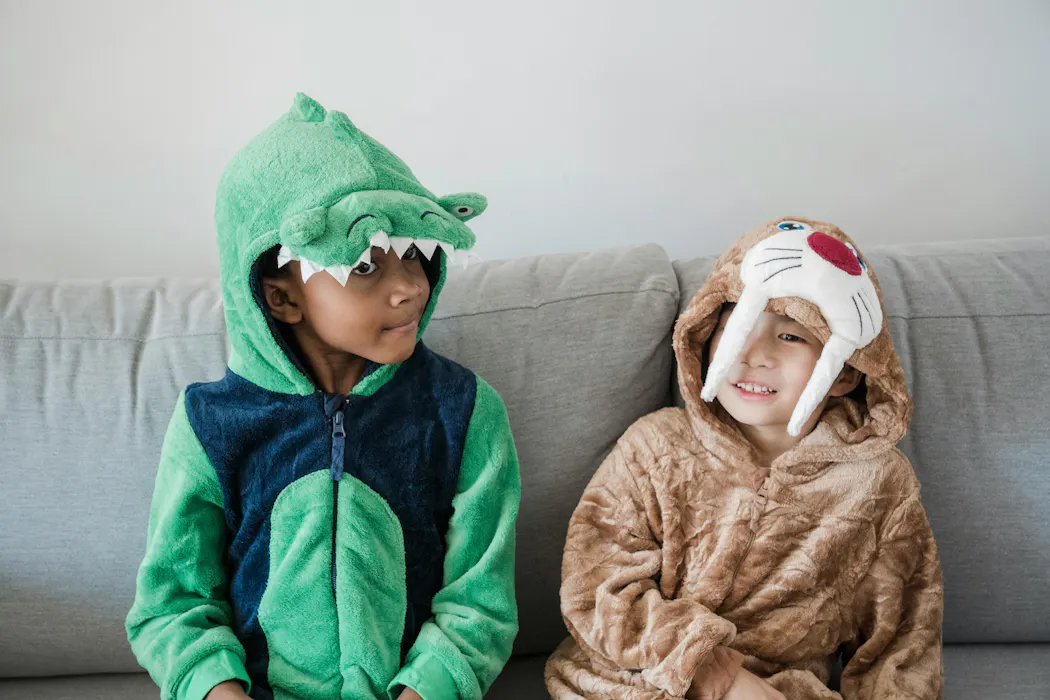
Often perceived as just a simple moment of play, “pretending” actually plays a key role in children’s development. It might even help prevent certain emotional difficulties, according to a new study.
Imitative games constitute an essential – and often magical – dimension of thechildhood.
Children have an overflowing imagination which they use to transform stones into spaceships, tables into huts, or pens into fairies. They can imagine being “mom” or “preparing dinner.” They can also invent their own characters, worlds, and concepts, unrelated to what adults would be able to imagine.
The ability to imitate generally appears between 15 and 18 months. Around20 months, children really begin to imitate the world around them. From the age of four or five, play becomes more complex andinvolvesinteractions with others as well as the embodiment of characters.
But beyond the fact that it is adevelopment stage, are there other benefits? Ourstudy suggeststhat pretend play can also promote mental health.
Our research
According to theWorld Health Organization, about one in seven children or adolescents is affected by mental health disorders. Most of the actions taken in response to this finding target the problems onetimes that they appeared, and very few are interested in the developmental foundations that would allow them to be prevented.
In our study, we analyzed data on more than 1,400 Australian children participating in theLongitudinal Study of Australian Children.
Their aptitude for pretend play was evaluated by early childhood professionals over a period of one year, when the children were between 2 and 3 years old. The aim was notably to observe to what extent a child was capable of:
-
engage in simple pretend play, such as feeding a doll or a stuffed animal
-
to use one object to represent another, for example a towel as a blanket or a box as a house
-
participate in pretend games with other children, using props or costumes to play roles (pretending to be a parent…)
Mental health outcomes were then measured based on observations from parents and early childhood professionals regarding emotional and behavioral difficulties, collected when the children were between 4 and 5 years old, and again between 6 and 7 years old.
What we observed
We observed that, among children aged 2 to 3 years, greater ease in pretend play is associated with fewer emotional and behavioral difficulties at 4-5 years, then at 6-7 years. These difficulties can, for example, manifest as frequent worries or repeated anger.
These results persist even when taking into account the children’s socioeconomic background, their mother’s mental health, their language skills, and the quality of the bond with their parents.
Why?
Emotional regulation – that is, the ability to manage one’s emotions and respond to them in an appropriate manner – has beenassociatedMental health during childhood and adolescence.
It is often assumed that children who are more comfortable with pretend play develop better emotional regulation, as this type of play would allow them to practice this skill.
But when we examined this link, we did not find an association between pretend play, emotion regulation, and later mental health outcomes. This suggests that other developmental mechanisms, still poorly understood, might be involved.
In our study, we propose that what is called “embodied cognition” could explain the link between mimicry play and mental well-being.
Theembodied cognitionis based on the idea that thinking does not take place solely in the head: the body and the way it interacts with the world also participate in cognitive processes.
Also to read:
Does counting on fingers help a child progress in math?
For example, when children learn to count with their fingers, the gesture itself is part of the way the mathematical concept is constructed in their mind.
Similarly, playing, imagining, and staging situations are not just forms of entertainment. These activities help children learn to think, feel, and react to their environment. This is undoubtedly what contributes, in return, to better mental health.
But further research is still necessary to be certain.
How to encourage pretend play?
Meanwhile, several simple gestures can help encourage imitation play in your child.
-
let the game play out for itself, without trying to make it a “learning moment.” If the child makes a mistake counting or naming objects during the game, it is better to prioritize the continuity of the game rather than interrupting it to correct them.
-
follow the child’s initiativewhen you participate, a bit like in a tennis rally. Waiting for the child to “serve the ball” helps keep the game centered on them, even if small suggestions can help them get started if they don’t quite know how to go about it.
-
react to the child’s playby simple observations or open remarks, rather than by instructions. Describing what is happening or wondering aloud about what will happen next can enrich the play without directing it. For example: “what could this leaf do?” rather than “this leaf can serve as a house for the pig.”
-
enter “into the game” rather than controlling it remotely.Adults can ask the child what role they would like to give them, or suggest embodying a secondary character, such as a somewhat lost visitor or a distracted customer.
Keep in mind that the game does not need to be complex or educational. It simply needs to feed children’s imagination. And as our study suggests, in doing so, it can also help protect their mental health.
Lucinda Grummitt, Sasha Bailey, Louise Birrell, Iroise Dumontheil, Gill Francis, Eliza Oliver, Olivia Karaolis, Robyn Ewing, Michael Anderson, Maree Teesson, and Emma L. Barrett are also authors of the research work mentioned in this article.

The study mentioned in this article is funded by the Serpentine Foundation and the National Health and Medical Research Council (NHMRC), through the NHMRC Investigator Grant (APP1195284) awarded to Maree Teesson.
–ref. Playing shopkeeper, doctor, or tea party can promote children’s mental health –https://theconversation.com/playing-shopkeeper-doctor-or-tea-party-can-promote-children’s-mental-health-281650