

Source: The Conversation – in French– By Speranta Dumitru, Lecturer, Université Paris Cité
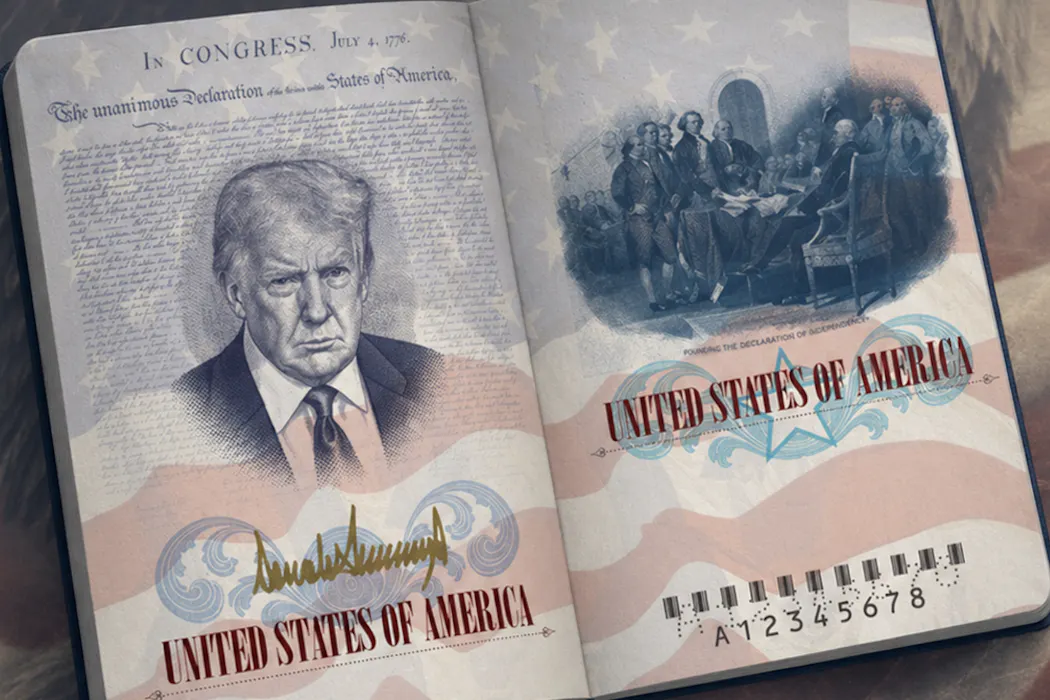
The passport bearing the effigy of Donald Trump is generating protests. However, their intensity is less than the anger provoked, after 1918, by the passport itself, which had been made mandatory during the First World War. On both sides of the Atlantic, the press demanded its abolition, considering it costly, humiliating, and a violation of freedom. A century later, the passport requirement has become normalized.
The White House recently announced that a limited edition of United States passportsAt the president’s effigywould be manufactured as part of the 250th celebrationseU.S. anniversary. These passports, which will feature an image of Donald Trump accompanied by his signature in gold ink, and whose exact number has not been made public, will only be available to citizens who request them in the city of Washington.
This decision immediately sparked intensereviewsA: some opponents see it as a manifestation of a cult of personality that no autocrat had ever dared to.
Is the “Trump passport” “embarrassing”? The verb “to embarrass” has two meanings: to cause shame, and to limit freedom. The detractors of this initiative feel embarrassed especially in the first sense: they are ashamed to see their president take advantage of the country’s independence anniversary to promote himself. But the second meaning, the one related to the restriction of freedom of movement, is much more lasting: for over a century, having to obtain a passport to travel has considerably bothered people all around the world.
The regime of mandatory passports
Our great-great-grandparents labeled the passport with all sorts of names: a “burden,” a “humiliation,” a “nuisance.” The system of mandatory passports, as we know it today, had beenintroduced during the First World War. The belligerent countries, such as France or the United Kingdom, established them from the beginning of hostilities, in August 1914. Initially, the justification was to be able to control the nationals of enemy powers. But to effectively control foreigners, it is necessary to monitor the entire population.
This is how the passport requirement proves to be doubly contagious: not only does it spread, in the belligerent countries, from foreigners to citizens, but it also spreads from the belligerent countries to the neutral countries. To allow their citizens to travel, all countries are forced to organize the issuance of passports. Let’s take the example of the United States. From January 1erIn August 1914, the Department of State asks its embassies in Europe to issue documents to U.S. citizens who are there without passports. Although as early as 1916 transport companies refuse to board passengers without passports, this is the first legal basis for controlling the entry and exit of citizens and foreigners in the United States.appears only in 1918, a little before the end of the war.
No one imagines that the passport requirement will persist after the end of the world conflict. At the time of the armistice, there is hope to return to the pre-war circulation regime. The League of Nations (ancestor of the UN) tries to respond — without success — to the demand for the removal or abolition of passports. Assome governments are stalling, the League of Nations proposes the simplification of border crossings by asking countries to adopt a uniform passport model — the one we know today.
Every passport is a “hindrance”
As early as 1918, the press echoed the public’s impatience. In France, hundreds of newspapers mentioned the abolition of passports: they announced it was forthcoming… throughout the entire interwar period.
Some article headlines illustrate the persistence of this expectation, although it decreases towards the end of the 1930s: “Down with the odious passport” (L’Humanité, December 21, 1921) ; « The absurd formality » (Le Figaro, May 19, 1923); “Let us abolish passports” (The Will, January 17, 1928); “The passport is a hindrance for honest people” (Le Quotidien, October 3, 1929) ; “The Death of the Passport” (Le Soir, April 14, 1931) ; “Passports must be abolished” (The Gazette of Biarritz-Bayonne and Saint-Jean-de-Luz, July 11, 1933).
One might think that the battle is led by left-wing newspapers.In my research, I have analyzed more than 700 articles mentioning the abolition of passports in the French press during the interwar period. My conclusion is that theThe majority of abolitionists are not left-wing, but from the right and center-right.Figaro, for example, the passport is seen as “the most unbearable administrative requirement for the French” because “one could not imagine what procedures, what troubles, what hassles” this “whole paperwork” inflicts on “honest people” (15 July 1921).
Even the far-right newspaperL’Action Françaisedoes not sabotage this “unanimity” and acknowledges that the passport is a “true hardship for the traveler.” Weighing “the pros and cons” of its removal, he recalls on September 7, 1921 that:
“In well-organized states, the passport is a serious guarantee against spies. A strong and far-sighted government, a good police force, can make it a solid weapon. It is up to them to minimize the inconveniences caused to the public by this document, while preserving it if necessary.”
In all the newspapers, the passion is evident: there is hope that “the annoying hindrance of this useless precaution that is the passport will soon no longer bemore than an unpleasant memory“or wishes that “passports, unnecessary, costly, and vexatious survivals of the past, be abolished from now on.” The emotion most frequently associated with passports is anger: “stupid obligation,” “shame of our time,” “bureaucratic flaw,” “one of the worst inconveniences,” “a source of annoyance for travelers,” “a scrap of paper,” “ridiculous formality,” “absurd,” “humiliating,” “harassment,” “the passport is a vain foolishness, a mirage, nothing”… When a newspaper publishes a user’s testimony, it apologizes for having to “remove the outraged terms he uses and the rather harsh judgments he expresses.”
In English, the “nuisance” of passports
The press does not react only in France. As the historian has shownCraig Robertson, in the United States newspapers refer to the negative public reaction as «passport nuisance» — the equivalent of the French «gêne» and «vexations». As in Paris, it is hoped that the passport requirement will disappear like other measures taken in wartime. The additional cost of travel is lamented, as in thisarticle ofNew York Timesfrom 1926:
“In the past, there was no need to worry about passports, unless traveling to pagan lands. But the war changed everything. We ended up imposing a visa fee of ten dollars, and other countries did the same. This generated revenue but also represented a heavy financial burden for travelers. Complaints multiplied, and Congress was called upon to find a solution.”
More than the cost of travel and administrative hassle, it is the reduction of freedom of movement that the media deplore. The hope for a return to the pre-1914 travel regime survives even after the Second World War. As illustrated by thisarticlefrom 1947:
“A sad remark on this backward progress was made by the International Chamber of Commerce: in 1914, a businessman could decide to travel from one capital to another and make the journey in just a few hours. Since 1914, trains have become faster, automobiles have become widespread, and the airliner has appeared. But the businessman, or any other traveler, may be forced to wait weeks, even months, between the moment he makes his decision and the moment he executes it. The Chamber considers this situation both “absurd and pernicious”.”
What hinders
A century ago, our great-grandparents would not accept waiting three days for a passport. Times have changed. Today, newspapers sometimes invite us to consider ourselves “lucky” when the wait lasts only a few months. Like this headline, from the sameNew York Times, “Need a passport? You’re in luck”which announced in 2024:
“For the first time since March 2020, processing times have returned to pre-pandemic normal [..] with six to eight weeks for standard service and two to three weeks for expedited service.”
When the constraint is no longer a hindrance but an opportunity, what remains is embarrassment.

Speranta Dumitru does not work for, does not advise, does not own shares in, and does not receive funds from any organization that could benefit from this article, and has declared no other affiliation than her research institution.
–ref. The “inconvenience” of the passport, beyond the Trump administration –https://theconversation.com/the-gene-of-the-passport-beyond-the-trump-administration-281912