

Source: French to English Tester Published on: 2026-05-05
Source: The Conversation – in French– By Mariève Blanchet, Professor in Physical Activity Sciences and Motor Development, Université du Québec à Montréal (UQAM)
The benefits of outdoor activities for young people are no longer debated: motor, cognitive, social, and emotional development, in addition to enhancing the effects of physical activity. Yet, they spend little time outside. This “nature deficit” has become a public health issue. What factors explain this disengagement, and how can they be brought back?
In order to better understand the phenomenon and to test solutions, we surveyed 465 parents. Our results confirm trends already observed in the scientific literature,in Canadaas elsewhere. Participation in outdoor activities decreases with age, and this decline is more pronounced among girls.At the global level, 81% of adolescents aged 11 to 17are considered physically inactive; girls are more so than boys, with a gap of up to 15% depending on the country.
Socioeconomic status also plays a roleA: young people from low-income families participate less in outdoor sports and are less interested in going outside. These families also have reduced access to outdoor activities due to transportation to outdoor facilities, or even because of the costs associated with the activities.
When a child has difficulties such as learning or motor disorders, thethe same observation is made. This decrease in participation could be a result of a low perception of their own abilities, safety concerns leading to overprotection, urban planning and accessibility constraints, as well as an increase in screen time.
Our study supports these observations by demonstrating that the interest in engaging in outdoor activities and sports outdoors is reduced among young people whose families have a low socio-economic status and among young people facing difficulties. Interactions even show that the effect of these factors can be cumulative. Thus, the tendency to self-exclude due to their functional challenges in activities is exacerbated when family income is low.
Also to read:
Nature and movement: an essential duo for the mental health of young people
The surprise: creativity endures
The most interesting result of our study concerns creativity in outdoor activities, which includes playing in the family residence yard, in the alley, or in a natural environment. In addition to overall participation, our questionnaire distinguishes three dimensions of participation, established from exploratory and confirmatory factor analyses.
1 — general interest in playing outside;
2 — participation in informal or organized sports;
3 — creativity in participation in outdoor activities.
Unlike the other two dimensions, the creativity score is not affected by gender, diagnostic status, or family income. It represents a potentially more inclusive and motivating entry point into the various activities practiced outside.
This observation opens up a concrete intervention path, linked to the approach“DYSactivation”developed in our laboratory. Rather than relying solely on structured sports activities, this approach offers a modifiable gradient of activities. This ranges from free play — initiated and defined by the child, with accessories that do not reference a sport or a predefined motor task — to games or sports organized by the adult. Within this framework, adult-structured activities aim to support the fundamental psychological needs of young people, for example by promoting cooperation and/or allowing them some choice in the activity.
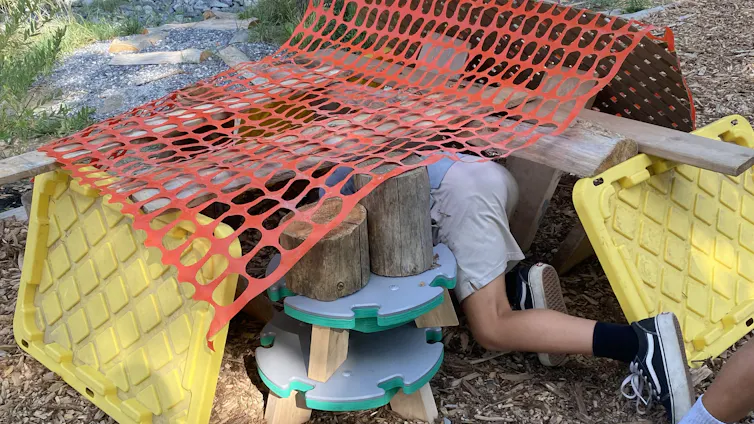
(Child Motor Skills Research Laboratory, EnJeuLab),CC BY
This approach has also been used in our En Mouvement spaces within the EnJeuLab network, such as the one ofBromont. We have built, based on evidence and our research results, innovative public spaces that rethink the way young people play, including the design of play accessories, layout, and infrastructure in order to continue our research. These spaces better reach young people who usually drop out by offering inclusive environments where creativity and a positive perception of their motor and physical skills play a central role.
Unlike traditional parks, which can encourage premature abandonment and exclusion based on children’s motor skill levels, EnJeuLab spaces offer a vibrant outdoor environment composed of various materials, natural or recycled.
Children and adolescents can freely design, deconstruct, and reconstruct objects or structures — such as cars, huts, or courses — alone or in cooperation with other young people. These creations are not predetermined and can take forms understood only by the participants.
Their imagination and autonomy guide their actions. Several young people even invent new games with the accessories. And if they do not wish to build, the space remains entirely open to their desires: running, climbing, hiding, crawling, or simply exploring. Various levels of difficulty and risk-taking are available in the space, as well as quiet and more isolated areas according to their needs. This type of environment allows young people to fully appropriate their play, in their own way.
When the child chooses to carry a log across a large play area, consisting of uneven terrain and various materials, their motor, physical, and cardiovascular skills are engaged. The route choices can include inclines and declines, as well as moving objects to wooden structures, for example to place them in a net.
This type of environment allows young people to be active in their own way.
Also to read:
Neuroscience allows us to understand what nature triggers in our brain
Already thousands of subscribers to the newsletter ofLa Conversation. And you? Subscribe to our freenewsletterto better understand the major contemporary issues.
Past experience and parental trust
Two other factors proved decisive. First, prior experience: the more a child has been exposed to a variety of outdoor contexts (organized leisure activities in the forest, outdoor education, outdoor camp, family camping), the higher their participation.
Then, when parents feel secure about their children’s outdoor activities, the child participates more. Moreover, these two factors significantly increase their child’s creativity dimension.
These results suggest that parental support is an underestimated lever. Training and reassuring parents about outdoor activities, while diversifying exposure contexts from a very young age, could have a lasting effect on participation, with benefits for children’s development and health.
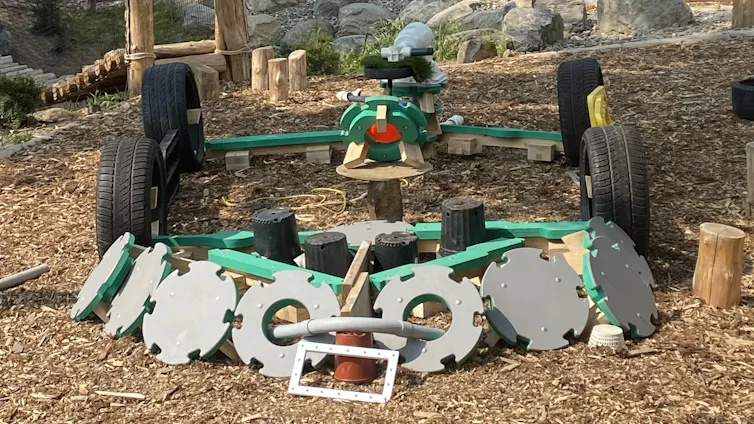
(Child Motor Research Laboratory, EnJeuLab),CC BY
Rethinking the offer for young people
One last observation deserves attention: outdoor creativity, although resilient to gender, difficulties, and income, also declines with age. This decline is partly explained by the available service offerings: as young people grow up, the activities offered become very structured and leave little room for imagination and free play. Yet research shows that even in adolescence, play continues to fuel creativity.
Rethinking the range of activities for preadolescents and adolescents by reintroducing spaces adapted to their age group where physical, sports, and leisure activities are created could help curb disengagement and reduce the alarming rate of sedentary behavior.

Mariève Blanchet has received funding from the Canadian Foundation for Innovation, the Social Sciences and Humanities Research Council, the New Frontiers in Research Fund, and the Quebec Health Research Fund.
Valentin TOP does not work for, advise, hold shares in, or receive funds from any organization that could benefit from this article, and has declared no other affiliation than his research institution.
–ref. Young people are abandoning outdoor activities. What if free play brought them back outside?https://theconversation.com/young-people-are-abandoning-outdoor-activities-what-if-free-play-brought-them-back-outside-278833