

Source: French to English Tester Published on: 2026-05-04
Source: The Conversation – in French– By Lucie Marinier, Full Professor of the Chair of Culture and Creation Engineering, National Conservatory of Arts and Crafts (CNAM)

The workMuseum and Ecology. Missions, commitments, and practicespublished, under the direction of Lucie Marinier, Aude Porcedda, and Hélène Vassal, in January 2026, in the “Musée-Mondes” collection of the French Documentation editions, presents the rich panorama of a sector that has “got underway” and that seeks, although still hindered by indicators marked by the notion of growth, to combine sobriety with ecological and civic commitments.
Faced with the climate emergency and the increasing attacks on living things, museums have to solve a difficult but decisive equation: to strengthen their social and cultural role to participate in the ecological redirection of society while reducing their impact on the environment. However, this isrealÂ: As an example, a large institution like the Quai Branly Jacques Chirac museum emits nearly 9000 tons equivalent CO2of GHG per year excluding visitor travel. Yet, the latter can account for up to 80 or 90% of the emissions of a cultural establishment.
For about ten years, particularly inCanadabut also in France, many museums are setting upmethodologiesto measure and reduce their negative impact and redouble efforts to disseminate scientific knowledge about the Anthropocene and its consequences on Earth’s habitability, helping to build anew imaginary.
This concerns thescience museumsbut also, although more recently, art museums. These latter, in addition to organizing exhibitionsecological art, develop hybrid initiatives with artists, environmental professionals (French Biodiversity Office,Ademe), climate scientists or activists. This was the case with the“Planetarium” programmingat the Centre Pompidou or the exhibition“One Hundred Works That Tell the Climate”at the Musée d’Orsay.
We are therefore facing a sector that has become aware of its impact and its responsibility and is seeking tothink differently, while museums continue to be assessed by the growth of their spaces and collections, the attendance of exhibitions, and the illusion of a stable climate allowing for the preservation of works in an ostensibly unchanging manner.
A common and coherent approach
The workMuseum and Ecology, under the direction of Lucie Marinier (professor at CNAM), Aude Porcedda (professor at the University of Quebec at Trois-Rivières), and Hélène Vassal (director of collection support at the Louvre Museum), has involved more than 90 stakeholders – museum professionals, scientists, and artists – who are committed to producing strategic guidelines, evolving the museum’s discourse, building citizen and participatory projects, and implementing concrete eco-responsible practices.
Because only global approaches, which concern cultural content but also the moderation of its production and dissemination, can sustainably establish the redirection of an institution. For this, new ways of building projects, more circular, more collective, are essential, which implies breaking down the silos between functions and integrating ecological issues as early as possible. The museum sector is made up of identified professions and the professionals are very connected, including at the international level, and these areby these networksthat new practices prevail.
Eco-responsibility projects are also an opportunity for new collaborations, a certain “sharing of legitimacy” between scientific and cultural functions and technical, production, and mediation functions, both internal and external to museums (for example fromscenographerswithin the Paris Musées institutions, which now asks them to design setups that can be at least partially reused for two or even three exhibitions while being relevant for each.
Experiments, oftencarried out by dedicated structuresorby institutions collectivelypromote these break-downs of barriers and collaboration withresearchers.
New professions (eco-advisors, referents in corporate social responsibility) are emerging. Several public policies have accompanied and supported these processes in recent years, often throughcalls for projects, ofguidesor innovative projects such as thegreen residences.
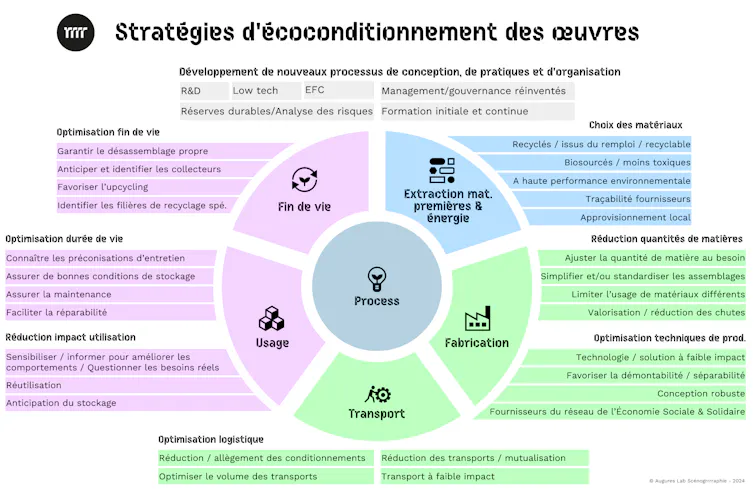
Studio dazd — Augures Lab Cultural Circular (formerly “Scenography”) 2024,Provided by the author
Museum professions reveal strong skills that are not only compatible with, but also promote ecological approaches. Three principles shared amongpreventive conservationand eco-responsibility appear central: sustainability, sobriety, and adaptation to risks. The ecological redirection carried out by museum missions and standards, rather than against them, thus seems to produce the most ambitious, innovative, and lasting transformations.
Note that the French and Canadian approaches, mainly presented in the book, have nuances. TheQuebec museums studiedhave a broader, socio-ecological approach, integrating the whole of17 Sustainable Development Goals (SDGs), including educational, participatory, inclusive, and decolonial issues. The French approach further separates programming content from the technical approach to sobriety. However, the “glass ceiling” that seems to be emerging calls for combining both approaches for a comprehensive and robust ecological redirection.
Breaking through the glass ceiling
Many professionals today express their frustration: they reach a glass ceiling once carbon assessments have been completed (more than 80% of which concern visitor travel), energy savings, and reuse measures. Public policies and cultural enthusiasm are declining, and attacks against scientific facts related to climate disruption are numerous.
Museums have made progress in terms of “ecological efficiency,” which allows them to maintain the same level of activity while using less energy and resources, but at the risk of producing“a rebound effect”A: it “costs less”, so more is done. Still too rare are those who truly assume the goal of sobriety, which consists of slowing down activity (lengthening the duration of exhibitions, reducing the number of artworks, having them come from less far away) but also re-examining programming, its relevance, its audience in light of socio-ecological issues.
This requires deeply rethinking, together with all professionals, funders, territories, and audiences, scientific and cultural projects in order to make different kinds of proposals, create new rituals, activate new values, and break with the “extractivist” logic inherent to the modern Western museum — this habit of taking works or objects, often from far away, to bring them to our museums.
Two avenues are explored at the opening of the work. The first is that of a museum reinforced in its capacities to participate in the care of people and ecosystems, which could also “accept” that populations give it new types of attention, more active, more “dialoguing.” An engaged museum in or for which one would get involved, notably on ecological issues.
The second is very concrete. Beyond voluntary sobriety, it is the urgent adaptation to climate change that museums are facing with the increase in frequency and intensity of episodes of heatwaves or heavy rain.The study conducted by Les Augures and Écoactshows that, in 2050, more than 50% of metropolitan French museums will experience an increase of at least 5 days in the number of very hot days and that 38 are already directly exposed to the retreat of the coastline.
Museums must conduct vulnerability studies in order to adapt (for the sake of the artworks but also the staff and the public) and to integrate these issues into their cultural and scientific projects. Artificially guaranteeing climatic stability is becoming a challenge; we must think differently: by imagining a different seasonality of the programming (for example, not using rooms under glass roofs in summer), by developing the thermal inertia of buildings, or by creating targeted microclimates for the most fragile artworks.
This situation can be distressing and lead to maladaptations. For example, faced with rising temperatures, one might be tempted to install new air conditioning units that will produce external heat and emissions.
However, some teams are now trying to consider a redirection of the museum accompanied by cooperation to participate in the adaptation of their territory, relying on specifically museum skills (museums that become refuges in case of heatwaves, greening of surroundings while respecting heritage aesthetics…).
The public-interest role of the museum could, without being questioned, develop to contribute to its own adaptation but also to that of its environment and its audiences.


Lucie Marinier does not work for, does not advise, does not hold shares in, nor receives funds from any organization that could benefit from this article, and has declared no other affiliation than her research institution.
–ref. What comprehensive approach for a modest and citizen-focused museum? –https://theconversation.com/what-global-approach-for-a-sober-and-citizen-museum-277563