

Source: French to English Tester Published on: 2026-05-06
Source: The Conversation – in French– By Krisztina Ilko, Junior Research Fellow, Queens’ College and Affiliated Lecturer at the Faculty of History, University of Cambridge

“Book of chess, dice, and tables”
In some medieval manuscripts, black and white players face each other on the chessboard within a framework of equality. A surprising iconography that shows how chess could embody a space where logic prevailed over racial hierarchies.
In the European medieval imagination, representations of racial difference were often very stark. Black people appeared either as exotic and prestigious figures — saints or wealthy sovereigns like the Queen of Sheba — or as dominated characters, judged inferior to white Christians. However, as my research showsresearch, chess offered another perspective: a space where players could compete on equal terms, regardless of their skin color.
Elements drawn fromBook of Games, subtitledBook of Chess, Dice, and Tables(Book of chess, dice, and tables), a game manual made for King Alfonso X the Wise in Seville in 1283, reinforced this idea. The manuscript contains 103 chess problems, each accompanied by a text indicating the winner and an illustration. These images depict a wide variety of characters, ranging from Jewish men to Muslim women. There are also Asian, white, and black players.
One of the most striking illustrations shows a black player and a pale-skinned player face to face on either side of a chessboard. The latter has a shaved head, indicating that he is a learned cleric. Yet, despite this marker of intelligence, the text states that the black player will win. In this “game of logic,” victory goes to the one who demonstrates the best strategic abilities. What matters most is the intellectual power of the player. As explained by theBook of Games, chess embodies wisdom, and those who study it acquire the ability to defeat others.
Another image from the manuscript shows five black figures surrounding the chessboard. In Western medieval visual culture, scenes depicting only black figures are rare and generally associated with negative connotations. Here, on the contrary, they appear in a highly intellectual setting and in an atmosphere that seems friendly.
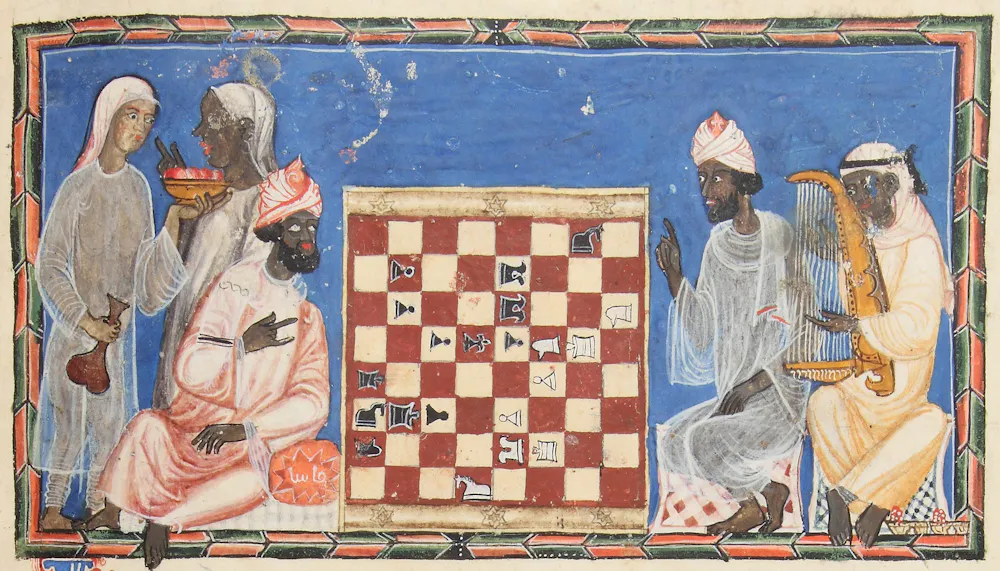
“Book of Games”
While chess has not eliminated the dominant social norms regarding racial prejudice, it has nonetheless offered players a space to challenge them within its own playful universe.
The representation of chess as a meeting between people of different skin colors was not limited to Europe. TheBook of KingswhereShāhnāmeh, an epic poem recounting the history of the Iranians from the creation of the world up to the Islamic conquest, thus tells of the introduction of the game in Iran.
According to theShâhnâmeh, an Indian king—whose name is not specified—sent an embassy to the Sassanid king with a chessboard and a challenge: to understand the rules or pay a tribute. Fortunately for the sovereign, his adviser Būzurjmihr managed to solve the enigma. A copy of the poem dating from the 14th century places this scene in a Mongol setting of the late Middle Ages. It shows Būzurjmihr, with lighter skin, facing the Indian emissary with darker skin.
Some researchers havesupportedthat the dark skin of the latter and his “loose clothing” were meant to highlight his defeat. But several clues suggest another interpretation. His “loose” tunic is richly adorned with gold, unlike the simple blue robe of Būzurjmihr, who was nevertheless the highest diplomat at court. His darker skin certainly refers to his foreign origins, but hardly makes him a negative character. On the contrary, he appears as the champion of the Indian rajah: the one who transmits the logic game and presents himself as the bearer of a highly coveted Indian knowledge.
The chess pieces themselves
Beyond representations of chess pieces, medieval perceptions of the «race” can also be studied through the plays themselves.
Chess spread throughout Afro-Eurasia from India in the 6th century to the rest of the known world. A war game, chess is based on pieces meant to represent soldiers. But, over the course of its diffusion, the shape of these pieces evolved, reflecting the societies that produced them.
For example, aking of chess with long hair, manufactured in Mansura or Multan (in present-day Pakistan) in the 9th or 10th century, reflects the ideals of Indian royalty. The famousLewis chess pieces, discovered in the Outer Hebrides in Scotland, but probably carved in Norway, are often considered the most emblematic representations of a medieval chess set. From this perspective, however, they only constitute a relatively late and geographically peripheral testimony of a much older tradition.
Medieval chess was not as black and white as the modern game. Some chessboards were white and red, or even blue and gold. Nevertheless, the alternating squares, just like the pieces themselves, were distinguished by contrasting colors. This allowed projecting onto the game someideas related to skin color and racial perceptions.
Onepoemfrom the 13th century explains that chess pieces “are the people of this world, taken from the same bag, like from a maternal womb, then placed in various places of this world.” The pieces could thus represent the different peoples of the globe. But the outcome of their confrontations on the chessboard remained determined by the rules of logic, and not by the color of their skin. Chess thus embodied a “just world,” where intellect, rather than religion or race, prevailed.

Krisztina Ilko has received funding from The British Academy.
–ref. In the Middle Ages, chess created a space where skin color did not matter –https://theconversation.com/in-the-middle-ages-chess-created-a-space-where-skin-color-did-not-matter-279972