

Source: French to English Tester Published on: 2026-04-29
Source: The Conversation – France (in French)– By Dan Mennill, Professor and Associate Dean of Science, University of Windsor

Paris has lost three decibels in ten years thanks to effective measures against noise pollution. But traffic noise still forces the birds to sing louder and louder.
In 1962, biologist Rachel Carson warned us inSilent Spring. This work, which has since become a major reference, warned about the silent world without birds that awaited us due to the uncontrolled impact of human activities.
Forty years later, biologists have revealed a striking effect of noise pollution on bird song. They discovered that the low-frequency noises of trafficforced the birds to sing at higher frequenciesin European cities. Thus, the birds in a noisy park located at the foot of the Eiffel Tower sing at a frequency 400 hertz (Hz) higher than that of their counterparts living in the quiet forests of the Parisian suburbs.
The study that I havepublished in the scientific journalOrnithological Applicationswith my colleagueHans Slabbekoornfrom Leiden University, however, shows that Paris is an example of success in the fight against noise pollution.
Yet, even though Paris has become quieter, the birds have not regained their natural singing tones. Our research shows that thecoal titsfrom Paris continue to sing at higher frequencies than birds from wild areas outside the city.
Chantal Dengis,CC BY72.5 KB (download)
It therefore seems essential to redouble efforts in reducing noise in urban areas worldwide in order to allow wild birds to communicate at their natural sound frequencies.
The devastating effects of noise
In fact, human activities flood the world with various noises. The sounds of cars, airplanes, boats, and industrial activities thus produce aconstant rumbling that affects wild animals, birds, and insects. We often neglect noise pollution as a conservation issue, even though it can have devastating effects on wildlife in an era of increasing urbanization.
For example, traffic noise disrupts the capacity ofbirdsand somefrogsTo attract partners. The noise of the boats leads to adecrease in vocal communication among whales. Finally, the noise of the trafficinfluence, for example, predator-prey interactions between moths and bats.
Since it was discovered that, in European cities, low-frequency traffic noises caused birds to sing at higher frequencies, this phenomenon has also been observed in various bird populations around the world.
In the Canadian prairies, the grassland sparrows thus emithigher-pitched sounds near noisy gas pumps. The familiar robinsThey themselves sing higher-pitched melodies in the presence of the noise from the wind turbines. It is also known that the grey-backed Australian Zosteropsproduce higher-pitched songs and calls in noisy urban areascompared to rural areas.
However, all these changes reduce the birds’ capacity todefend their breeding territories and attract mates.
Also to read:
Preserving the oceans from human noise to better protect them
Fighting for a quieter city
Paris is one of the largest andmost densely populated in Europe, but Parisians have developed innovative strategies to combat noise pollution.
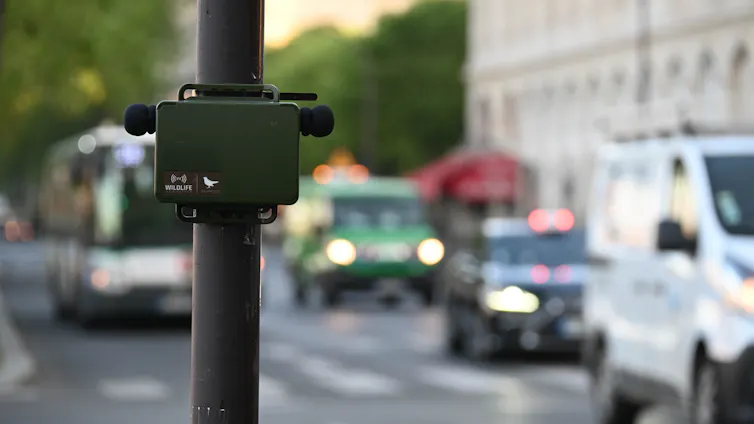
The city hastransformed many traffic lanes into bike lanesand has laid noise-reducing coatings on the main road axes.
Dan Mennill
Sound radarsalso impose fines on vehicles that are too noisy. A regional observatory calledBruitpariffinally monitors noise throughout the city and oversees noise reduction efforts.
All these actions aim to make the city calmer, both for the inhabitants and for the wildlife.These efforts against noiseHowever, they raise the following question: can the level of noise pollution be reduced in order to minimize its impact on bird song?
A brake on the noise
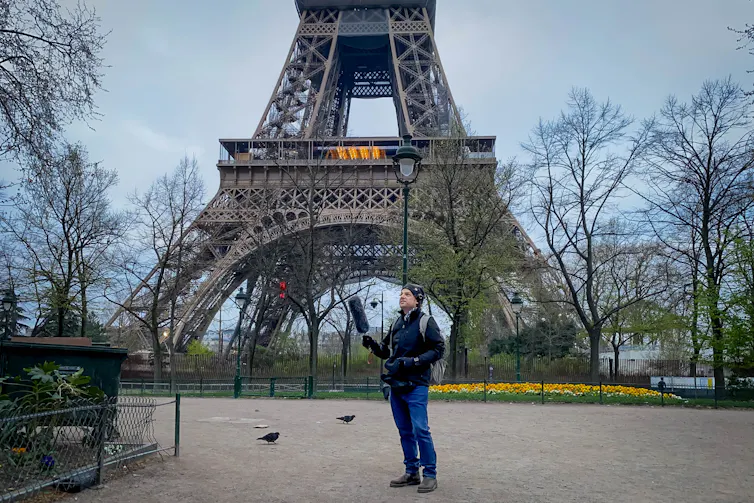
In 2023, I went to Paris to record the song of the great tit, a common bird in European gardens.
I used microphones and digital recorders to record the birds in the streets, squares, and parks throughout the city. I followed the footsteps of my collaborator, Hans Slabbekoorn, the biologist who had been the first to record the great tits in Paris in 2003.
Dan Mennill
By comparing the background noise to the birdsong, we found that the great tits emitted higher-pitched songs in noisy environments. By singing at a higher pitch, they thus avoid having their song masked by low-frequency traffic noise.
We also analyzed the noise data collected throughout Paris by Bruitparif. We thus observed that Paris is on its way to winning the battle against noise pollution and that the city has become quieter in recent years.
Indeed, Paris is now about three decibels quieter than it was ten years ago. Asthe decibel scale is logarithmic, a decrease of three decibels represents a significant reduction in sound intensity. But despite these advances, the coal tits of Paris continue to sing at higher frequencies than those of birds living in wild areas outside the city.
Birds can change their song
There are, however, reasons to be optimistic. Research conducted in other cities has shown that when the environment becomes less noisy, birds regain their natural tone.
Thus, the calm observed in the streets during the Covid-19 lockdowns provided a rare opportunity to study birds in a quieter world. Biologists from San Francisco (California) thus noted that theurban soundscape had become about seven decibels quieter during the lockdowns– levels rarely seen since the 1950s.
This ambient calm allowed the birds to modify their songs. In San Francisco, white-crowned sparrows reacted by singing deeper and softer melodies.
Many bird species have thus benefited from this calming that prevailed during the lockdown period. As part of a study on 47 species of songbirds in North America, our research team found that thespecies whose song covers a wide range of frequencies – that is, sounds least sensitive to the effects of low-frequency noise – have expanded their rangeduring this period of calm.
These results show that noise pollution affects various bird species, even those whose song seems well adapted to noisy environments.
Listening to the future
Our studies conducted in Paris show that a three-decibel reduction is not sufficient to allow birds to regain their natural singing frequencies. Additional noise reduction efforts will therefore be necessary so that we can adequately share the sound space with our feathered friends.
Paris also offers us a lesson full of hope in the fight against noise pollution. Cities can reduce noise by encouraging cycling and quieter modes of transport. Public policies also play an important role, as illustrated by the Bruitparif agency in Paris.
If we measure noise pollution, we can strive to reduce it, improve our own well-being, and create a space that allows wild birds to communicate at their natural sound frequencies.

Dan Mennill received funding from the Natural Sciences and Engineering Research Council of Canada
–ref. In Paris, birds continue to sing at a higher pitch because of the noise, despite the fight against noise pollution –https://theconversation.com/in-paris-birds-keep-singing-sharper-because-of-noise-despite-the-fight-against-noise-pollution-281659