

Source: French to English Tester Published on: 2026-05-05
Source: The Conversation – France in French (3)– By François Drémeaux, Lecturer-Researcher in Contemporary History, University of Angers
The beginning of the epidemic, ongoing aboard the MVHondius, this cruise ship faced with a suspected outbreak of hantavirus infection and turned away by the Cape Verde authorities, highlights both the difficulty and the importance of managing health crises at sea. A historical perspective shows that current developments replicate old patterns.
Three dead, five suspected cases, passengers confined at sea, and a country refusing access to its port: the episode revives recent images and others more distant anchored in the collective imagination, those of ships in quarantine offshore, laden with invisible threats.
In Marseille in 1720, theplague arrives by theGreat Saint Anthony, returning from the Middle East, and decimates the city in the following months, notably after long hesitations about the sanitary measures to be applied. More recently, in 2020, theDiamond Princess, immobilized off the coast of Japan with its 3,600 passengersat the beginning of the Covid-19 pandemic, had illustrated the vulnerability of modern ships to infectious diseases. TheHondiusis part of this series of events where the sea becomes a space of isolation as much as of crisis.

Oceanwide Expeditions
While epidemics can nowto spread rapidly through air transport, such an incident at sea gives the impression of being able to stop time and control the situation. For epidemiologists, these are textbook cases that allow the disease to be studied in slow motion; for historians, it is also an opportunity to observe the effectiveness of ancient practices. For at sea, epidemic management follows specific logics.
Until the beginning of the 20th centuryeIn the century, the long crossings of ocean liners were potential incubators for infectious diseases. Cholera, typhus, or various fevers could break out during the voyage, and the health organization was then planned accordingly. Depending on the country, doctors on board gradually became mandatory from the 1850s, isolation protocols on board were implemented, and above all, ports improved rigorous health surveillance systems.The protocols implemented at Ellis IslandFrom 1892, to control European migrants arriving in the United States, they proceeded with this logic.

Private collection
Maritime health and the Western empires
Along the maritime routes that formed the backbones of globalization in the 19th century, first in the Mediterranean and then through imperial expansions, Europeans organized a complex system of health surveillance. This was done both to protect themselves from their neighbors, to assert their domination over certain countries — notably colonized ones — and also to ensure a smooth flow of goods and passengers among them. Maritime health thus became an imperial issue. Approaching the coasts, so-called boarding doctors would come on board to assess the sanitary condition of the ship.
In case of suspicion, the vessel was refused the license that allowed it to freely conduct its trade, and the passengers were directed to a lazaretto, a quarantine place often located away from cities. These infrastructures formed an essential network of international health security. They gradually disappeared after World War II, under the combined effect of medical progress and the shift towards air transport, which was much faster.

Collection French Lines & Compagnies,CC BY-NC-ND
This change in temporality has profoundly altered the dynamics of epidemics. The incubation periods of diseases have not changed, but travel durations have drastically decreased, including on cruise ships whose objective is often to multiply land stops (aa little over seven days on average). The so-called exploration cruises in remote areas anda fortiorithe so-called circuits of repositioning from one hemisphere to the other – like the one carried out byHondiusuntil now — precisely represent exceptions due to the increase in the number of days at sea, in the current case between Ushuaia (Argentina) and Praia (Cape Verde) and despite stops at the South Georgia Islands and Saint Helena.
As a result, infections today tend to appear more after landing than in open sea. The case ofHondius, which here offered a forty-six-day journey, thus appears as a resurgence of an old pattern where the illness manifests on board and necessitates a closed-loop management.
Lessons from the Covid-19 pandemic
It seems obvious that lessons have been learned from the Covid-19 pandemic. During the quarantineof theDiamond Princessin Japan in 2020, the lack of clarity in the information given to passengers and in staff training have been widely highlighted as aggravating factors. The cruise sector, which has been rapidly expanding in recent years and is expected to represent a market of 37 million individuals by 2025, has apparently evolved on the issue since the staff arenow trained and strict protocols are in place on board.
Paradoxically, with current means of communication, the closed-door nature of theHondiushas quickly become a global event. Our contemporary societies, traumatized by the Covid-19 pandemic, have reverted to precautionary isolationist instincts. Just a few miles from the port of Praia in Cape Verde, theHondiuswas denied access to the territory while one passenger had already died on Saint Helena and two others had been evacuated to South Africa.The Regional Director of the World Health Organization (WHO) for Europe, Hans Klugehe judged that “the risk for the general public remains low. There is no reason to give in to panic or to impose travel restrictions.” However, the media coverage that the event has received since the beginning of the crisis says a lot about the fears of spreading.
During the 19th centuryeTo century, and notablyfacing major cholera pandemics, international regulations have been developed to harmonize responses and fend off health hazards. In 1887, for example, the countries of the South American cone adopted the Rio Convention to protect their internal commercial relations and guard against extra-continental epidemics. These maritime health regulations were then strictly enforced, notably by Argentina, because these measures also helped assert the independence of states against the pressures of Western powers. Cape Verde’s refusal to welcome theHondiuscan be read through this prism. It is a precautionary act, but also a political decision of sovereignty.
The maritime doctor, still an essential actor

Collection French Lines & Company,CC BY-NC-ND
At the heart of these events is a figure often forgotten: the maritime doctor. Heir ofmilitary navy doctors, its role was structured within the merchant navy in the 19th century, notably in France through the reforms of 1876 and 1896 which professionalized shipboard medicine. Even today, aspecialized training still exists in France in Brest(Finistère), preparing practitioners to intervene onboard or from land but always “in a maritime situation.” The episode ofHondiusemphasizes the importance of these skills, at the intersection of medicine, epidemiology, and logistics in constrained environments.
The specificity of the maritime environment is not only due to isolation. It also concerns disease vectors and, in this case, infection withhantavirus, which is suspected in this case, is transmitted by rodents. Even if it is highly unlikely that the disease originates from the ship’s interior rather than from a port stopover, the event serves as a reminder that thefight against ratsis a constant in naval history.
The drastic measures implemented in the 19th century are effective and allow for a clear decline in the populations of murids on board. The fumigation of the holds in particular, or simply the installation of metal discs on the moorings to prevent rats from boarding, are among the major advancements. Despite this, thepresence of rodents on board is never completely eradicated. Paradoxically, the number of rats found dead — but healthy after autopsy — at the end of a crossing was often considered an indirect indicator of the health status of the ship. The presence of a plague-infected animal corpse signaled the health alert, even before a human case appeared.
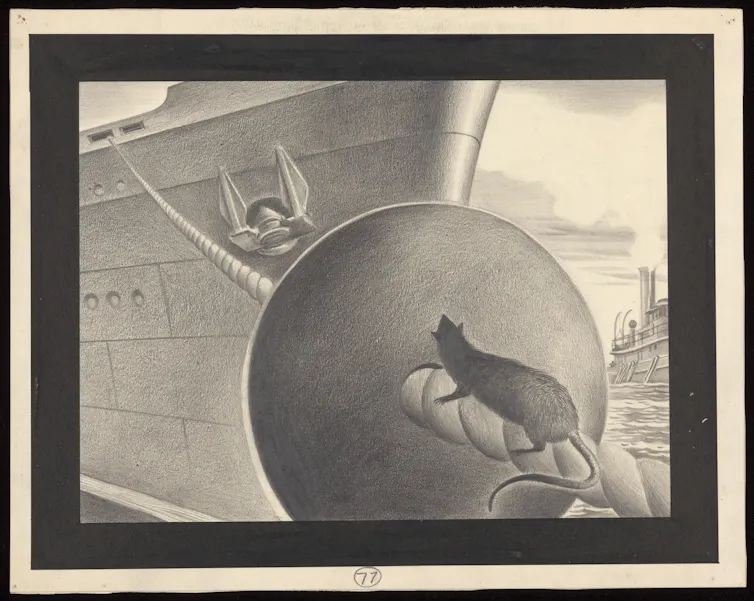
Wellcome Collection,CC BY-NC-ND
These elements remind us that the sea remains a unique environment, where health balances are fragile. They thus invite reinvestment in fields of study sometimes neglected, both in the maritime and health domains. In recent years, theMaritime historians are paying more attention to the lives of seafarers. A study day dedicated to health in the maritime environment, entitled“Prevent and Cure – Organizing Health at Sea (17th-20th century)”, will also be held on May 13 at the University of Angers (Maine-et-Loire), a sign that these issues continue to engage researchers.
Far from being a simple anomaly, the episode ofHondiusthus acts as a revealer. It shows that, despite the transformations in mobility and health systems, some old configurations may reemerge. And that, in the face of health uncertainty, societies reconnect, sometimes almost instinctively, with practices inherited from several centuries of maritime experience.
The study day “Prevent and Cure”, on the history of health at sea, will be held on May 13, 2026, at the University of Angers (Maine-et-Loire).

steamer.hypotheses.org/3570,CC BY

François Drémeaux received funding from the European Commission under a Marie Skłodowska-Curie Actions contract for the SHIPPAN (Shipping Pandemics) research program.
–ref. Floating quarantine on the “Hondius”: the long history of health crises at sea?https://theconversation.com/quarantaine-flottante-sur-le-hondius-la-longue-histoire-des-crises-sanitaires-en-mer-282175