

Source: French to English Tester Published on: 2026-04-29
Source: The Conversation – in French– By William Barter, UKRI Future Leaders Fellow, School of Physics and Astronomy, University of Edinburgh
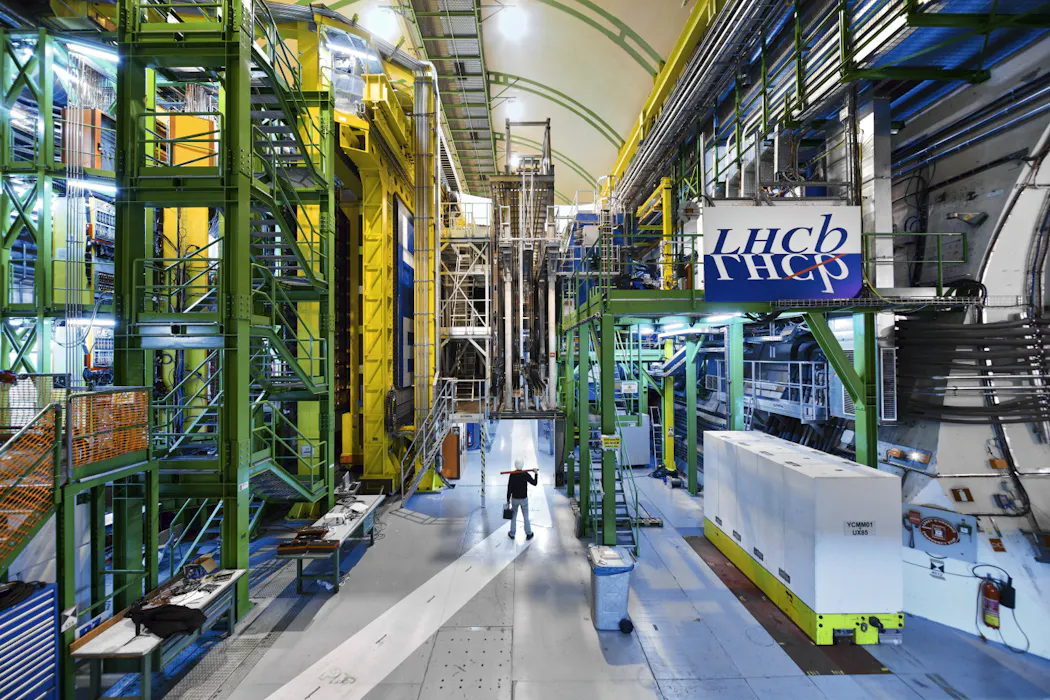
Results obtained at the Large Hadron Collider, or LHC, the CERN’s large hadron collider, could call into question the Standard Model, a cornerstone of particle physics for half a century.
Are we on the verge of detecting signs of physics yet unknown? That is what the recent research results we are conducting at seem to suggest.large hadron colliderof CERN (Large Hadron Collider or LHC).
If these clues were confirmed, they would call into question the theory – calledstandard model (SM)Å – which has dominated particle physics for fifty years. The results indeed indicate that the behavior of certain subatomic particles in theLHCis not consistent with the predictions of this model.
Fundamental particles are the elementary building blocks of matter: indivisible subatomic particles (which cannot be decomposed into smaller units). Four fundamental forces – gravitation, electromagnetism, the weak interaction, and the strong interaction – govern their interactions.
The LHC is a huge particle accelerator installed in a 27-kilometer circular tunnel beneath the Franco-Swiss border. Its main objective is precisely to put to the test thestandard model.
This theory constitutes our best understanding of fundamental particles and forces, but it is not complete. It does not account for gravity nor thedark matter– this form of invisible matter, never before directly measured, which would represent about 25% of the universe.
At the Large Hadron Collider, beams of protons circulating in opposite directions are collided in order to detect signs of still unknown physics. The new results come from LHCb, an LHC experiment dedicated to the analysis of these collisions.
This result is based on the study of the decay – a form of transformation – of subatomic particles called B mesons. We analyzed the way in which theseB Mésonsdisintegrate into other particles, and found that this specific process does not conform to the predictions of the standard model.
An elegant theory
The standard model is based on two of the most revolutionary advances in 20th-century physics: quantum mechanics and Einstein’s special relativity.
Physicists can compare measurements made in facilities like the LHC to predictions stemming fromstandard modelin order to rigorously test this theory. Despite its incomplete nature, more than fifty years of increasingly stringent tests have yet to reveal any flaw in this theoretical framework. At least, until today.
Our measure,accepted for publicationin the magazinePhysical Review Letters, highlights a gap of four standard deviations compared to the predictions of the standard model.
Concretely, this means that, after taking into account the uncertainties related to experimental results and theoretical predictions, the probability that a random fluctuation of the data produces such a large deviation – if the standard model is correct – is about 1 in 16,000.
Even if this result remains below the ultimate standard of physics – what is called thefive sigma, that is five standard deviations (about a one in 1.7 million chance) — the evidence is beginning to accumulate. This hypothesis is reinforced by results from another experiment,CMS, published earlier in 2025.
Although the results from CMS are less precise than those from LHCb, they are in good agreement with the latter, which consolidates the whole. Our new results come from the study of a particular type of process, called an electroweak “penguin” decay.
Rare events
The term “penguin” refers to a particular type of disintegration (transformation) of particles with a very short lifetime. In this case, we study how the B meson decays into four other subatomic particles – a kaon, a pion, and two muons.
With a bit of imagination, the configuration of the particles involved can evoke the silhouette of a penguin. Above all, the study of this decay allows us to observe how one type of fundamental particle, thebottom quark, can turn into another, thestrange quark.
This “penguin” decay is extremely rare within the Standard Model: out of one million B mesons, only one decays in this manner. We have precisely analyzed the angles and energies at which these particles are produced during the decay, and have accurately determined the frequency of the process. Our measurements of these parameters do not match the predictions of the Standard Model.
The detailed study of this type of decay has been one of the major objectives of the LHCb experiment since its inception in 1994. “Penguin” processes are particularly sensitive to effects of new potentially very massive particles, which cannot be produced directly at the LHC. Such particles can nevertheless exert a measurable influence on these decays, in addition to the expected contribution from the Standard Model. This type of indirect observation is not unprecedented. For example, a form of radioactivity was discovered nearly eighty years before the fundamental particles responsible for it – theW bosons – are not observed directly.
Perspectives
The study of these rare processes allows us to explore aspects of nature that may not become accessible otherwise except with particle colliders that will be available at best only in the 2070s. A wide range of new theories could explain our results. Many of them involve new particles called“leptoquarks”, which unify two types of matter constituents: leptons and quarks.
Other theories consider more massive particles, analogous to those already described by the standard model. These new results allow constraining these models and guiding future research.
Despite our enthusiasm, open theoretical questions remain and prevent us from asserting with certainty that we have observed physics beyond the standard model. The main difficulty lies in the “charming penguins” (charming penguins), a set of processes predicted by the standard model whose contributions are extremely difficult to estimate. Recent assessments suggest that their effects are not significant enough to account for our data.
Moreover, the combination of a theoretical model and experimental data from LHCb indicates that these “charming penguins”—and therefore the standard model—struggle to explain the observed abnormal results.
New data, already collected, should allow us to make a decision in the coming years: in our current work, we analyzed about 650 billion B meson decays recorded between 2011 and 2018 to identify these “penguin” processes. Since then, the LHCb experiment has recorded three times more B mesons.
Other advances are planned in the 2030s in order to take advantage offuture improvementsof the LHC and to constitute a dataset 15 times larger. This decisive step could provide definitive evidence – and, perhaps, pave the way for a new understanding of the fundamental laws of the Universe.

William Barter works for the University of Edinburgh. He receives funding from UKRI. He is a member of the LHCb collaboration at CERN.
Mark Smith does not work for, advise, own shares in, receive funds from any organization that could benefit from this article, and has declared no other affiliation than his research organization.
–ref. An anomaly at the LHC suggests a major breakthrough in particle physics –https://theconversation.com/an-anomaly-at-the-lhc-suggests-a-major-breakthrough-in-particle-physics-281164