

Source: French to English Tester Published on: 2026-04-05
Source: The Conversation – in French– By Manon Cerdan, PhD student researcher, Aging and Media, University Paris-Panthéon-Assas
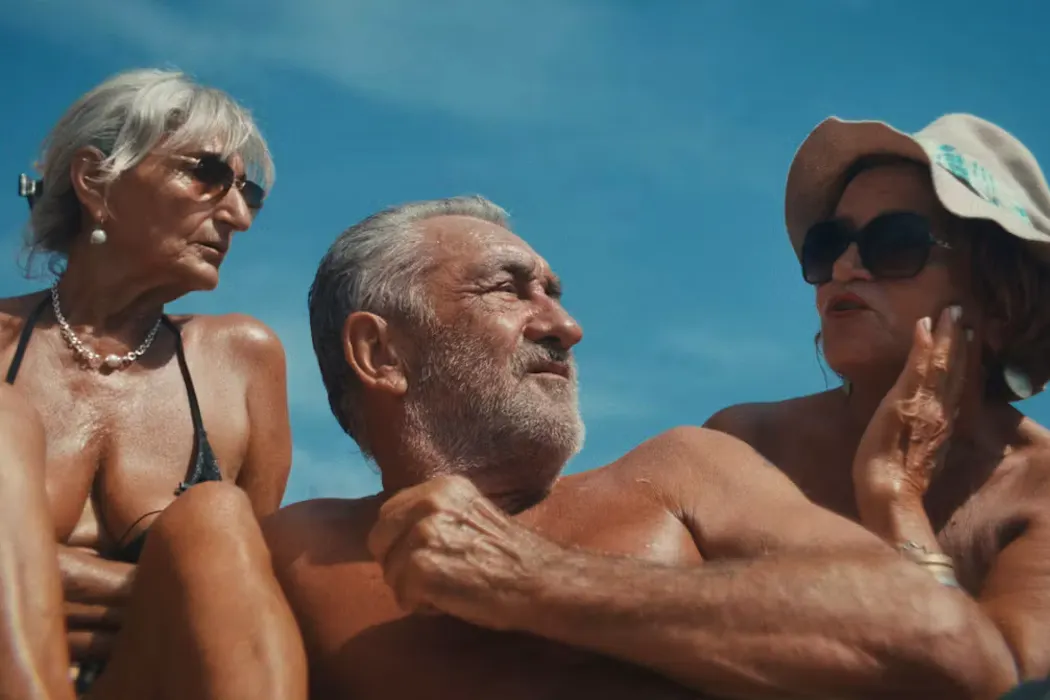
Between the renewal of imaginaries, persistence of stereotypes, and emergence of new forms of storytelling, the representations of the sexuality of elderly people in cinema and series reveal the evolution of our collective relationship to aging and desire.
The awards season is coming to an end, and looking back, a trend is emerging: old age now has its place in cinema, including in awarded works.
Amy Madigan is crowned at 75 years old for her role asterrifying old womaninFaintedby Zach Cregger; the César for Best Short Documentary was awarded toLadies’ Bath, by Margaux Fournier. Not forgetting the success of the filmMaspalomas, from Jose Mari Goenaga and Aitor Arregi at the Goyas – notably marked by the best actor award for José Ramon Soroiz, who is also 75 years old.
But this new visibility is not limited to a mere recognition of elderly people: it reveals a deeper shift in representations. InAt the Ladies’ BathorMaspalomas, it is indeed the sexuality of people over 70 years old that is portrayed, a subject long relegated to the margins, even struck by invisibility. Audiovisual production thus appears as a privileged space to question social norms, challenge age-related taboos, and redefine the contours of intimacy in advanced age.
The sexuality of the elderly: an unthinkable and a “hidden” until the late 2000s
Addressing the issue of aging often requires defining an age category. A high-wire act since old age – like youth – is a period of life that is, on the one hand, relatively long, and on the other hand, experienced differently by individuals. How can fixed categories be created when there seems to be more of a continuum punctuated by turning points? How does one move fromdynamic young retireeto the nursing home resident? Fiction rarely bothers with this type of precision and relies on a certain number of symbols — and themes — to characterize the character’s old age.
For a long time, until the late 2000s, sexuality did not appear as one of these themes. It is rather a“unthinkable” of old age,As sociologist Rose-Marie Lagrave says, noting that “the sexuality of the elderly remains shameful, hidden, repressed, and relegated to the sidelines of society.” She continues her reflection by considering that “only fictional novels seem to create a transgressive space for impossible confessions.”
Perhaps one could broaden the discussion to audiovisual fiction. Thus, in 2012, the researcher in information and communication sciences Ariane Beauvillard, in her book onold age in French films and series,notes in its conclusion a “novelty that has appeared in recent years: almost absent or limited to a few references and light suggestions, the sexuality of the elderly gradually integrates into films that deal with old age.” It then cites several French films, includingTogether, that’s all, by Claude Berri (2007),It has to dance!, by Noémie Lvovsky (2007),My Father’s Guests, by Anne Le Ny (2010), or eventhe Little Streams, by Pascal Rabaté (2009). It does not mention international cinema but, at that time, the South Korean film was also releasedToo young to die, by Park Jin-pyo (2002), and the German filmSeventh Heaven, by Andreas Dresen (2008).
If nowadays young retirees no longer really surprise when they experience love and desire, the generation over 70 years old, on the other hand, is now asserting itself in the realm of intimacy.
A revival of representations of sexuality in old age
Since 2010, new examples of films depicting the sexuality of older people, notably women, have emerged in French cinema –She is leaving, by Emmanuelle Bercot (2013), with Catherine Deneuve at the dawn of her 70s;Rose, by Aurélie Saada (2021), with Françoise Fabian aged 86 years;the Young Lovers, by Carine Tardieu (2022), with Fanny Ardant aged 70 – international – let us mentionMy appointments with Leo, by the British Sophie Hyde (2022), orMy favorite cake, Iranians Maryam Moghadam and Behtash Sanaeeha (2025).
Television series are not left out, although the subject is not the main theme. If the HBO seriesTell me you love me(2007) paved the way and directly showed the sexuality of different couples, including a couple in their seventies, Netflix has also tackled the theme with the emblematicGrace & Frankie(2015-2022) performed by Jane Fonda and Lily Tomlin, orthe Kominski Method(2018–2021) with Michael Douglas. Also mention the multi-award-winning HBO seriesHacks(2021-) in which we follow the sexual life of the main character, Deborah Vance, an aging comedian who must reinvent herself.
Of interest to show sexuality with elderly characters
Romantic issues, intimate and individual quest, initiatory journey, questioning of norms, power relations… Sexuality offers varied narrative possibilities. When portrayed through elderly characters, it allows revisiting, from a renewed perspective, fears both intimate and universal, often associated with the “first time” or the rediscovery of pleasure. Thus, inRue Málaga(2026), by Maryam Touzani, when Carmen Maura evokes a pleasure she thought lost after years of abstinence, the identification is not so much through the character’s age as through her position as a “beginner”: an experience to which everyone can relate, regardless of their age.
Old age enriches the representation of sexuality by opening up new narrative perspectives. This is notably the case in the seriesSeventh Heaven(2023), by Alice Vial, created by Clémence Azincourt, where Jacques and Rose, residents in a retirement home, free themselves from performance demands. Their relationship allows more room for sensuality, slowness, and forms of pleasure that go beyond mere penetration.
Age thus becomes a lever to renew the treatment of sexuality and question the norms that frame both old age and sexuality. A parallel can be drawn with theTeen Series, which can contribute to emotional and sexual education – as demonstrated by the researcherDominique PasquierAboutHélène and the Boys. These fictions, which depict awkward, imperfect sexualities, sometimes funny or non-heterosexual, are not only aimed at teenagers. They attract a wider audience, seeking more diverse and less normative representations, allowing for the redefinition of what is perceived as “normal,” “acceptable,” or simply possible.
The female directors seem to take a particular interest in this theme, portraying women who age without giving up desire, as evidenced by the cited examples. This movement is particularly visiblein the series. However, reducing this vital momentum to the sole dimension of sexuality would be insufficient. The renewal of representations also involves highlighting active professional and social trajectories.
Series likeVera’s Investigations,Harry WildwhereCéleste, illustrate this evolution: their heroines, far from the stereotypical images of old age, continue to work and fully engage with the world. In short, contemporary fiction helps to redefine the contours of female aging, showing that an elderly woman is no longer reduced to the figure of a solitary grandmother but can embody a plurality of roles, desires, and possibilities.

Manon Cerdan does not work for, advise, hold shares in, receive funds from any organization that could benefit from this article, and has declared no affiliation other than her research organization.
–ref. Aging bodies, living desires: a discreet revolution is unfolding on the screens –https://theconversation.com/ageing-bodies-living-desires-a-discreet-revolution-is-playing-out-on-screens-279010