

Source: French to English Tester Published on: 2026-03-30
Source: The Conversation – France (in French)– By Cécile Touitou, Head of the Foresight Mission at the library / DRIS, Sciences Po
In just three years, generative artificial intelligence has established itself as an essential tool in students’ research routines, disrupting their way of learning while also profoundly reshaping their relationship with books, even in fields like the humanities where books have long held a central place.
In an information-saturated landscape, what strategies do European students develop to conduct their academic research? Between the quest for efficiency and time pressure, they would favor “profitable” content, often preferring to rely on AI to obtain summaries rather than consult primary sources.
This is what the information skills barometer initiated by the network of librarians of the European University Alliance teaches usCIVICA. Theresultsof thisinvestigationtransnational, conducted in partnership with Ifop, testify to a tense ecosystem and highlight a risk of misuse of generative AI. They also allow us to question underlying trends in our societies, such as the relationship with the book.
Until now central in learning, particularly in fields like humanities, is the book, in digital or paper format, now being supplanted by other resources and tools?
Google and ChatGPT first… libraries next?
For a student, conducting research, reading books, and broadening learning has always been an essential condition for success. As the ocean of information expands, navigating it becomes more complex, even more anxiety-inducing.
What if AI not only made it possible to access this “universal library” but also to “ingest it” without reading, thereby bypassing a path perceived as fraught with obstacles to the original text in its entirety?
The efforts made to search for information are limited for most respondents, but a significant minority devote “a lot” of time to it. This activity increases as students progress in their studies. While 41% spend two to five hours per week on it, an equally significant proportion (41%) spend six hours or more, with 24% of doctoral students even reporting spending more than ten hours weekly.
Nearly 55% of respondents mention the stress generated by the abundance of sources, the percentage rises to 62% among the doctoral student population, and even 64% for law students.
They search, think they know how to do it… but do they do it effectively given the very great heterogeneity of the interfaces and the complexity of the documentary perimeters of each of these reservoirs? Academic librarians observe daily the fragility of their skills in this area.
When asked about their basic knowledge, students feel confident, but their confidence erodes when it comes to the most technical skills. About 73% feel at ease finding information and 71% evaluating its reliability, but this figure drops to 58% for managing bibliographic references and to 54% for using university databases.
Internet search is the default entry point (71%); this refers to generalist search engines like Google, which 67% of master’s students report using, and 49% of doctoral students. However, the latter prefer academic search engines like Google Scholar (76% versus 49%).
Respondents state that generative AI has become – in just three years – a common use (61%), ranking second in responses, ahead of reading lists provided by teachers (59%) and far ahead of library catalogs (38%). Self-reported use of AI for academic purposes varies greatly depending on the student’s university. This wide variation in levels of use also reveals a great diversity according to levels and disciplines as well as institutional and academic support.
Printed books: a usage that varies according to the level and discipline
In 2025, digital technology fragments student time, invades downtime, and imposes trade-offs based on academic profitability. In this context, how can one find the time to “read”?
To the statement “My university workload is so heavy and the deadlines so tight that I don’t have enough time for thorough and critical reading,” 73% of bachelor-level students agree, 76% of master’s students, and 69% of doctoral students. Seven out of ten master’s students even declare “most of the time, I read summaries of books or articles rather than entire books/articles” (4.5 out of 10 for doctoral students)!
If oneobservesan erosion of printed book loans and electronic consultation in all university libraries worldwide, what is the concrete situation regarding student practices?
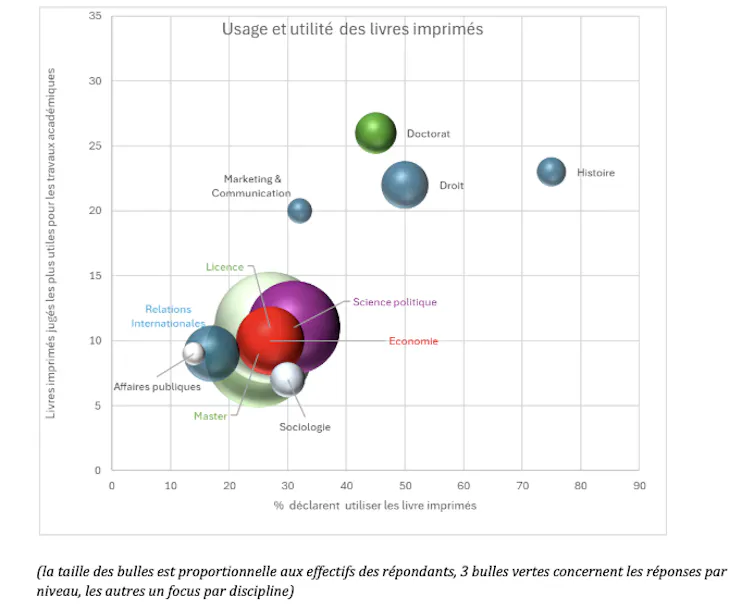
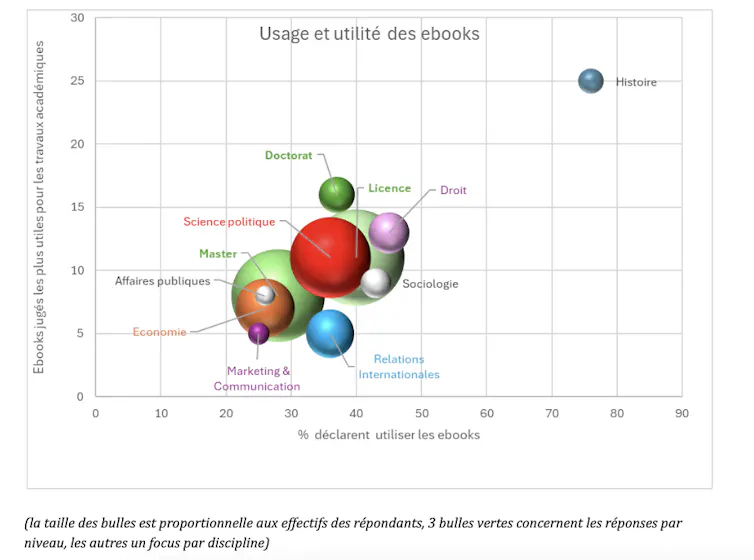
Only 17% of respondents cite books and/or e-books among their “most useful or relevant” sources for academic work, but 46% declare that they use them. This gap is significant: books are used, but not considered as reference resources. This is particularly true for bachelors and sociology students in the CIVICA alliance panel where the gaps are the largest.Conversely, it is for doctoral students and history students that it is the weakest. Responses by level (LMD) or by discipline show very different situations between usage and perceived usefulness by sub-population, as can be seen in the following graph.
The use of printed books is generally low, but this average masks very polarized realities: while 28% of respondents say they use them to search for information related to their work, this is the case for 25% in master’s programs versus 45% in doctoral programs; 75% in history versus 14% in Public Affairs.
Provided by the author
And if, instead of students distancing themselves from printed books, we were simply witnessing a specialization of uses based on needs, editorial offerings, and the type of work in each discipline? For example, low users of printed books may consult articles online.
Printed books seem to have become a niche resource, mainly used by doctoral students in work requiring in-depth literature or in fields where digital is less developed. For the younger ones, lack of time, low academic profitability, or lack of taste for reading are among the explanations that can be given for this massive disaffection, even though there are still avid readers.
What use of e-books?
If they no longer read on paper, do they do so online as many have thoughtmediaNearly 65% of students say they prefer the digital version over paper when they have a choice between the two versions, especially doctoral students (75%) more than bachelors (63%), reflecting an acclimation with years of study to a more practical reading of the digital medium and a better understanding of the ecosystem of online scientific publications.
Provided by the author
The declared usage of e-books is on average 6 points higher than that of printed materials (12 points for bachelor’s students!), yet only 33% of respondents declare using them; 22% use them all the time or frequently, 12% sometimes; but 67% rarely or never! It is therefore observed that the medium is not the solution to this problem.
Overall, 75% of master’s students declare that they do not use printed books, and 72% do not use digital books, a finding that raises many questions. Master’s students seem to prefer other types of resources, notably academic databases.
For many, quickly finding recommended books can become an obstacle: scattered reading lists, incomplete references, low visibility of available copies or digital versions… So many barriers that prompt some students to turn to more easily accessible sources, even if they are sometimes less reliable or less suitable.
Massive adoption but mixed confidence
Alongside these changes impacting the relationship to print, AI has become an essential tool for students, but this massive adoption is not accompanied by equivalent confidence in the generated content nor by clear institutional recommendations.
AI is not systematically considered to be academically relevant. The gap between frequent use and perceived usefulness suggests heterogeneous practices: some students rely on AI as a common aid tool, while others use it occasionally or remain skeptical about its academic value.
About one in two students would trust AI to generate ideas for a research project. Trust collapses when AI is used for source searching and referencing. Students give AI a high rating for translation (86% reliability) and a relatively high rating for summarization (71%) and understanding complex concepts (69%), but their trust drops sharply for searching scientific articles (38%) and suggesting sources (32%), precisely where errors can compromise academic quality.
Within three years, the use of AI to bypass direct reading of a text, obtain a summary, or extract key ideas has become a common practice, a new stage in the evolution of young people’s reading habits.studiedSince the end of the last century. A “utilitarian” relationship to the book imposes itself in an information ecosystem undergoing rapid change where the temptation of intermediaries who facilitate access and appropriation of content can be seen as either a risk or an opportunity.
This article was written by Cécile Touitou, head of the “prospective” unit of the Sciences Po library, with the collaboration of Sophie Forcadell, European university CIVICA project officer at the Sciences Po Paris library..

Cécile Touitou is the chair of the CN 46-8 commission of Afnor “Information and documentation – Quality, statistics and evaluation of results.”
Sophie Forcadell is a member of the LIBER academic libraries.
–ref. Read to learn? How AI is transforming students’ relationship with libraries –https://theconversation.com/read-to-learn-how-ai-is-transforming-students-relationship-with-libraries-277570