

AM Edition: Here are the top 10 security intelligence articles on LiveNews.co.nz for April 2, 2026 – Full Text
Why Iran targeted Amazon data centers and what that does – and doesn’t – change about warfare
April 1, 2026
Source: MIL-OSI-Submissions-English
Source: The Conversation – USA – By Dennis Murphy, Ph.D. Student of International Affairs, Georgia Institute of Technology
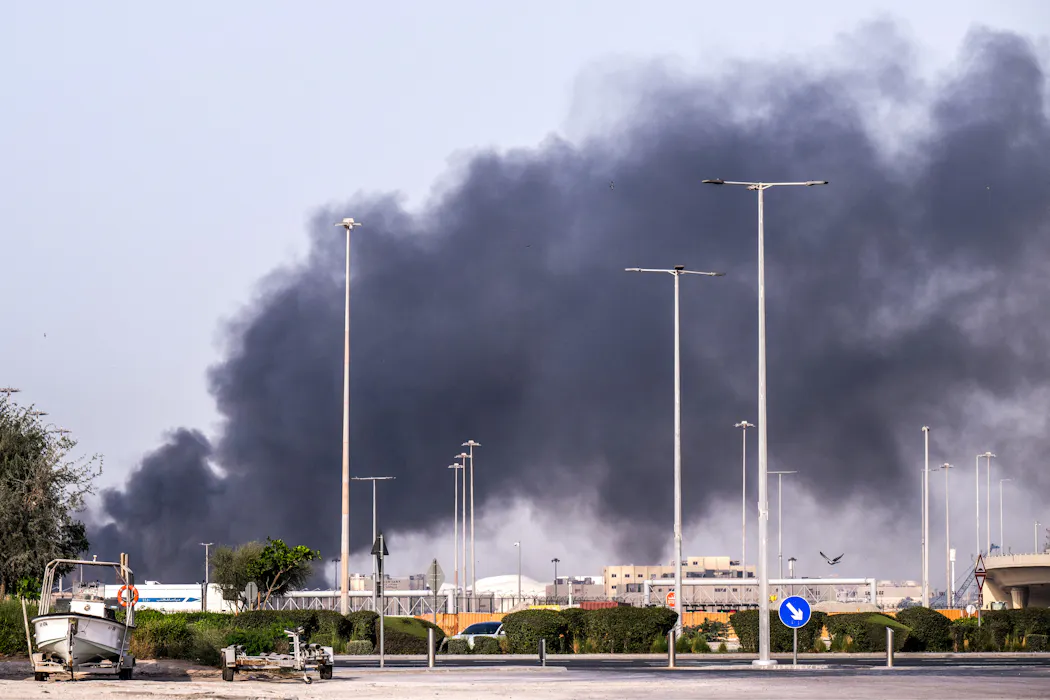
Before dawn on March 1, 2026, Iranian Shahed drones struck two Amazon Web Services data centers in the United Arab Emirates. A third commercial data center in Bahrain was hit, though it is less clear whether it was deliberately targeted. Iran has also indicated that it considers commercial data centers to be targets.
This is the first time that a country has deliberately targeted commercial data centers during wartime. Data centers have been targets of espionage and cyberattacks in the past, notably when Ukrainian hackers destroyed data stored in a Russian military-affiliated data center in 2024. This, however, was a physical attack. Drones damaged buildings.
Advances in artificial intelligence have increased the importance of data centers. The U.S. military, in particular, has made great use of AI systems for decision support in its attacks on Iran and Venezuela. Given how important data centers are, Iranian forces could be targeting the infrastructure Iran’s leaders believe is supporting strikes on Iran.
It is not altogether clear that these particular data centers were used by the U.S. military. Instead, the attacks may have been part of a broader effort to punish the United Arab Emirates for its ties with the U.S.
In my experience as a Ph.D. candidate at Georgia Tech studying how technology drives changes in international security, I don’t think the attacks signal any significant change in the nature of warfare. But they are forcing nations to recognize that data centers are targets of war – even if they don’t directly support military operations.
Data centers and the cloud
The United States military is increasingly incorporating advanced AI capabilities into its decision support systems. From the operation to capture Venezuelan President Nicolás Maduro to supporting military strikes against Iran, the U.S. has been using AI, especially Anthropic’s Claude, for intelligence analysis and operational support.
AI is unlocking faster ways to carry out operations in war, but the AI tools the military often uses are not located on a plane or ship. When a service member uses Claude, the computing infrastructure that powers the model and its analysis usually goes to a secure Amazon Web Services cloud that hosts secret government data and software tools.
Commercial data centers are where the cloud lives. The next time you pull up Netflix and watch your favorite shows, you are likely streaming the programming from a data center, possibly AWS. When AWS data centers go down, outages affect all sorts of entertainment, news and government functions.
With AI as a driver of economic growth, data centers are key forms of infrastructure. They ensure that AI can continue to run, as well as much of the underlying internet that governments and industry rely on. When Iran attacked the UAE’s data centers, it caused widespread disruption to the local banking system.
Commercial data centers enable most of the technology that runs the modern world, including AI systems. Disrupting them is key to disrupting the military and society of a country. Given that AWS provides and operates many of the commercial data centers where the cloud lives, it is likely that its data centers will continue to be targeted in conflict.
Going after US allies
Researchers at Just Security noted on March 12, 2026, that the United States requires cloud-computing service providers to store government and military data within the U.S. or on Department of Defense bases: “Moving such data to Amazon data centers in the Gulf region would require special authorization; we are unaware if that has been granted.”
Nevertheless, Iran’s Islamic Revolutionary Guard Corps claimed the strikes were against data centers supporting “the enemy’s” military and intelligence activities. And 10 days after the initial attack on the data centers, an Iranian news agency claimed that major tech company data centers and other physical assets in the region were considered “enemy technology infrastructure.”
Instead of military reasons, Iran may well have targeted the UAE to rattle the global economy and garner attention. Given the prominence of the Gulf as a major recipient of U.S. technological investment, the attack may also have been a symbolic one aimed at the heart of U.S.-Gulf cooperation. AI infrastructure such as commercial data centers is a growing part of U.S. leadership in the region, and this war could jeopardize the future of AI infrastructure in the Gulf.

Giuseppe CACACE/AFP via Getty Images
Growing importance, easy targets
Though data centers are increasingly important for national security, the economy and society at large, it can be tempting to suggest these strikes represent a fundamental shift in the nature of war. While that is a possibility, it is important to remember that Iran launched thousands of missiles and drones at targets in the UAE. Though the vast majority were intercepted, the two that struck data centers are a small portion of the ones that got through to civilian targets in UAE territory, including strikes on airports and hotels.
The relative vulnerability of commercial data centers – they are large, relatively fragile and lack dedicated air defenses – suggests that the ones in the UAE may have been targets of opportunity or convenience. In other words, they were hit because they could be hit.
Nevertheless, it seems likely that as the use of AI tools and other cloud-based resources continues to grow in importance for countries around the world, commercial data centers will be targets in future conflicts.

Dennis Murphy is affiliated with Georgia Tech, the Georgia Tech Research Institute, the RAND Corporation, the Notre Dame International Security Center, and the Astra Fellowship. He previously was affiliated with Lawrence Livermore National Lab, Marine Corps University, and the Cambridge University ERA Fellowship.
– ref. Why Iran targeted Amazon data centers and what that does – and doesn’t – change about warfare – https://theconversation.com/why-iran-targeted-amazon-data-centers-and-what-that-does-and-doesnt-change-about-warfare-278642
Back to index · Read original article
Bobi Wine’s decision to flee Uganda points to a shrinking landscape for opposition politics
April 1, 2026
Source: MIL-OSI-Submissions-English
Source: The Conversation – Africa (2) – By Kristof Titeca, Professor in International Development, University of Antwerp
Bobi Wine’s escape from Uganda is not just a striking episode in itself, it also offers insight into the current state of the opposition – particularly his National Unity Platform party – and into the divergences within the Yoweri Museveni regime.
The Ugandan opposition leader had been in hiding for almost two months after the January 2026 presidential election, which Museveni won by 72%. Wine came second with 25% of the vote. Museveni, 81, has been in power since 1986.
Wine, born Robert Kyagulanyi, entered formal politics in 2017 when he won a parliamentary by-election.
He soon emerged as one of the leaders of the People Power movement, a loose, generationally charged mobilisation built around the slogan “People Power, Our Power”. It took shape in the aftermath of protests against the removal of presidential age limits in 2018. At the time, the opposition appeared largely exhausted and unlikely to unseat the regime. Bobi Wine and People Power therefore brought a new energy to Uganda’s opposition.
People Power later formalised into the National Unity Platform party, which Wine used to vie for the presidency in 2021. He secured about 35% of the presidential vote against Museveni’s 59%. National Unity Platform became the largest opposition force in parliament with 57 seats.
These results also highlighted the constraints of electoral politics in the face of extensive repression.
This is a pattern that would again become apparent in the 2026 elections.
As several human rights organisations noted, the 2026 elections took place in an environment marked by widespread repression and intimidation.
After the vote, Wine went into hiding. He posted photos and videos seemingly from Kampala, triggering roadblocks and searches across the capital city. On 18 March 2026, he resurfaced in the United States.
I have researched Ugandan politics for over 20 years, and recently published an article analysing the structural challenges Wine’s political party faces in Uganda’s authoritarian context.
Drawing on this work, my reading is that Wine’s escape reveals controlled tensions within Museveni’s regime, where different factions appear to disagree on how to handle the opposition – without signalling a full split. At the same time, it exposes a deeper dilemma for Wine and his party: how to balance international advocacy with maintaining grassroots legitimacy at home.
This moment matters because it highlights the structural constraints facing opposition politics in Uganda, and raises questions about whether meaningful political change can occur within the current system.
Frictions within the regime
The contrasting approaches within the Museveni regime are illustrated by events that followed the 2026 election. In the weeks following the vote, defence force chief Muhoozi Kainerugaba (Museveni’s son) issued a series of unusually explicit statements about Wine.
In a now-deleted tweet, he claimed that 22 members of the National Unity Platform – whom he labelled “terrorists” – had been killed. He added that he was praying that the next death would be Wine’s.
On 26 January, the defence chief escalated this rhetoric, stating that he wanted Wine “dead or alive”. These statements built on earlier threats, including about beheading Wine.
Taken together, they amount to sustained violent threats directed at the main opposition leader.
Read more:
Uganda’s autocratic political system is failing its people – and threatens the region
Set against this, however, is the fact that Wine was able to evade capture for nearly two months and ultimately leave the country.
It emerged that he did so with assistance from high-level state and security officials.
The same sources and regime insiders reported that intelligence services had informed Museveni about Wine’s whereabouts. The president chose not to act upon this information.
Taken together, these events suggest differences within the regime between factions in the security services, or more broadly between Muhoozi and other centres of power. Potentially even within the first family itself.
But these differences should not be overstated.
The episode does not indicate an open or consolidated split. Criticism of Muhoozi within the regime remains tightly constrained.
What this suggests is a regime where disagreements are contained within narrow limits. Wine’s escape, therefore, points less to a rupture than to an ongoing negotiation over power and strategy within the ruling elite.
And this is becoming increasingly important in light of the anticipated transition beyond Museveni.
Tensions within Wine’s party
Wine’s political strength has always come from where he came from.
He was rooted in the ghetto, and more broadly among urban youth who had long been mobilised by opposition politics but rarely felt represented by it.
Earlier figures like Kizza Besigye could appeal to this group, but Wine embodied it. He spoke the same language and made politics feel accessible to people often treated as outsiders.
That sense of authenticity was central to the early momentum of People Power. It also mattered that Wine broke with a long-standing pattern in Ugandan politics: he did not come from the western region, the core of the ruling elite.
But this “outsider” appeal has become harder to sustain over time. As People Power turned into a political party, and as Wine himself became more embedded in formal politics and international networks, parts of that original base began to feel that something had shifted.
What once felt like a movement of “one of us” increasingly risks being seen as something closer to the political establishment it set out to challenge.
As my research shows, this is not unusual. It is a core dilemma when protest movements turn into parties, especially under repression.
The social media backlash to Wine’s appearance in the United States needs to be read through that lens.
It not only echoes criticism from Museveni that Wine is an “agent of foreign interests”, but also from within the opposition where some radical voices argue that he should have stayed and faced the regime, even if that meant prison. Besigye, for instance, is facing treason charges after he was abducted and extradited from Kenya in 2024.
This criticism echoes a longstanding divide within opposition politics in Uganda: should opposition leaders embody defiance on the ground, or navigate politics through institutional spaces?
Read more:
The making and breaking of Uganda: an interview with scholar Mahmood Mamdani
Being in the US reinforces a growing perception that Wine is becoming more distant from the people who carried the risks on the ground.
If the party cannot connect its international advocacy and diaspora support back to the everyday struggles of its supporters in Uganda, this episode will likely deepen the feeling that the party has become more of the same.
What role remains for Wine?
There is an uncomfortable reality here. Wine serves a function for the regime. His presence helps maintain the appearance of political competition, particularly within the international community.
Wine now faces a choice. Engaging in electoral politics risks reinforcing the system he seeks to challenge. Stepping outside it risks isolation, repression or loss of political relevance.
How he navigates this tension will shape not only his political trajectory, but also that of his party.

Kristof Titeca does not work for, consult, own shares in or receive funding from any company or organisation that would benefit from this article, and has disclosed no relevant affiliations beyond their academic appointment.
– ref. Bobi Wine’s decision to flee Uganda points to a shrinking landscape for opposition politics – https://theconversation.com/bobi-wines-decision-to-flee-uganda-points-to-a-shrinking-landscape-for-opposition-politics-279475
Back to index · Read original article
New Israeli law could mean death penalty by default for Palestinians convicted of deadly attacks
April 1, 2026
Source: MIL-OSI-Submissions-English
Source: The Conversation – Global Perspectives – By Shannon Bosch, Associate Professor (Law), Edith Cowan University
Israel’s parliament, the Knesset, this week passed legislation that would vastly expand capital punishment in Israel and in the occupied Palestinian territories.
The changes, made via an amendment to Israel’s penal law, allow for executions without proper appeal, pardons or meaningful judicial discretion.
According to media reports, 62 of 120 Knesset members voted in favour of the bill on Monday, including Prime Minister Benjamin Netanyahu, and 48 voted against. The remainder absented themselves from the vote or abstained.
UN experts and Amnesty International have warned these new death sentencing rules would apply almost exclusively to Palestinians.
It would, they argue, entrench discrimination already identified by the International Court of Justice as amounting to apartheid. UN experts said of the bill:
Since Israeli military trials of civilians typically do not meet fair trial standards under international human rights law and humanitarian law, any resulting death sentence would further violate the right to life […] Denial of a fair trial is also a war crime.
This development is a significant change for Israel, which has not executed anyone for more than 60 years. It reverses decades of global movement towards abolition, while normalising executions in an occupied territory.
Death penalty as the default
These changes were made via legislation brought by National Security Minister Itamar Ben-Gvir and his far-right Otzma Yehudit party.
The Penal Bill (Amendment ― Death Penalty for Terrorists) amends both Israeli civil law (applicable to Israeli settlers) and Israeli military law (applicable to Palestinians) in the occupied West Bank.
The law states, according to a Deutsche Welle media report:
Palestinians in the occupied West Bank convicted of terrorism in military courts will face a mandatory death sentence or, in the wording of the bill “his sentence shall be death, and this penalty only.” Only if the court determines that there are “special reasons” can it then commute the death sentence to life in prison.
Under this change:
- prosecutors do not need to request the death penalty
- the defence minister may submit an opinion to the judicial panel of three military officials who only need a simple majority to impose the death penalty
- judges need to record exceptional reasons for imposing a life sentence over the death penalty
- avenues for appeal would be tightly restricted
- there would be no possibility of a pardon
- people sentenced to death would be detained in isolated facilities that would have restricted visitor access, with legal counsel only by video link
- executions (by hanging) would take place within 90 days of the final judgement.
Another yet-to-be-passed bill that may still be brought before the Knesset – the Prosecution of Participants in the October 7 Massacre Events Bill – would also see more death sentences handed down.
It establishes ad hoc military tribunals with retrospective jurisdiction to prosecute those accused of participating in the October 7 2023 Hamas-led attacks on southern Israel.
These tribunals would:
- consist of a retired district court judge and two officers qualified to serve as judges
- be authorised to depart from ordinary rules around evidence and procedure
- be able to impose the death penalty via a simple majority, without prosecutors requesting it.
Appeals and clemency mechanisms would again be extremely limited.
Taken together, the two amendments significantly expand the scope of capital punishment in Israel. They also remove many procedural safeguards.
Supporters argue capital punishment could deter future attacks and preclude hostage-taking for prisoner exchanges.
Yet, historically, Israel’s intelligence services have opposed death sentences. They have argued it may encourage armed groups to kidnap Israelis as bargaining chips to prevent executions.
International humanitarian law
Critics have argued the new changes place Israel in breach of international humanitarian law and international human rights law.
As critics point out, Israel’s new death penalty rules limit access to legal counsel. They also:
- restrict appeals
- allows trials before ad hoc military tribunals for new capital offences
- mandate executions be carried out within 90 days.
This all runs counter to international humanitarian law.
Significant legal concerns are raised by Israel enforcing new capital offences in the occupied territory after the International Court of Justice concluded Israel’s occupation violates international law and must cease.
These concerns are compounded by longstanding criticisms of Israeli military courts in the occupied West Bank, where conviction rates for Palestinian defendants reportedly exceed 99%.
International human rights law
Under international human rights law people should be guaranteed equality before the law and protected from discrimination.
But the changes passed by the Knesset this week subject Palestinians to death sentences as the default, while Israeli citizens accused of killing Palestinians would appear before civil courts. Here, capital punishment would be discretionary and far more limited. This entrenches a discriminatory system.
Critics argue this amounts to collective punishment against Palestinians, which is prohibited under the Geneva Convention.
The European Union has warned that executions through hanging would also violate the absolute prohibition on cruel, inhuman or degrading treatment.
Taken together, the two new amendments normalise state-sanctioned executions and violate Israel’s obligations under international law.

Shannon Bosch does not work for, consult, own shares in or receive funding from any company or organisation that would benefit from this article, and has disclosed no relevant affiliations beyond their academic appointment.
– ref. New Israeli law could mean death penalty by default for Palestinians convicted of deadly attacks – https://theconversation.com/new-israeli-law-could-mean-death-penalty-by-default-for-palestinians-convicted-of-deadly-attacks-279458
Back to index · Read original article
Iran’s attacks drone on, with the U.S. at risk of losing the war
April 1, 2026
Source: MIL-OSI-Submissions-English
Source: The Conversation – Canada – By Michael J. Armstrong, Associate Professor, Operations Research, Brock University
The United States and Israel have repeatedly boasted about airstrikes in their current war with Iran. In Week 1, they claimed the destruction of 75 per cent of Iran’s missile launchers. By Week 2, they had reduced Iranian missile fire by 90 per cent and said the war was “already won in many ways.”
And yet, Iran keeps damaging refineries and blocking tankers from crossing the Strait of Hormuz.
The country has certainly suffered many tactical losses. But its missiles and drones have been strategically successful.
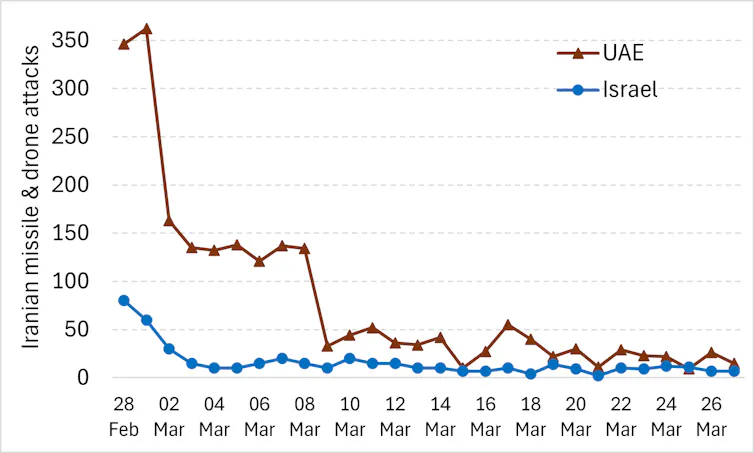
Iran so far has launched at least 5,400 such projectiles. Surprisingly, less than a tenth of them have targeted Israel, its traditional rival.
Missiles over Israel
Israel faced about 450 Iranian missile attacks during the war’s first four weeks. The rate of fire fell rapidly after the first weekend but has never halted.
Some missiles carry several hundred kilograms of explosives, enough to destroy an entire building. The rest instead dispense dozens of cluster bombs over wide areas. Those are less powerful but still lethal.
Israel’s long-range Arrow interceptors engage the missiles first. Its mid-range David’s Sling and short-range Iron Dome interceptors provide backup. (The country’s Iron Beam lasers are not being used.) Together, they’ve reportedly intercepted 92 per cent of incoming missiles.
But interceptors sometimes miss. And their supply is limited. Consequently, at least nine large warheads and 150 cluster bombs have hit populated areas.
These numbers imply that almost all Iranian missiles are accurate enough to need interception. By contrast, during Israel’s earlier conflicts with Gaza in 2008, 2011 and 2014, less than a third of incoming rockets were so accurate.
Meanwhile, more than 90 per cent of Iran’s missiles and drones have targeted Arab countries in the Persian Gulf.
Published news reports, CC BY
Drones across the Persian Gulf
Saudi Arabia, Jordan, Iraq, Kuwait, Bahrain, Qatar, Oman and the United Arab Emirates (UAE) collectively reported around 4,900 Iranian attacks during the first four weeks. Only one fifth were missiles: the rest were drones.
These countries have stated they are neutral in the war. However, they do have defence agreements with the U.S., and some host American military facilities.
These countries defend themselves using weapons like the U.S.-made Patriot and Israeli-made SPYDER interceptors. Drone experts from Ukraine now advise the defenders too.
For example, the UAE reported attacks by 1,835 drones, 378 ballistic missiles and 15 cruise missiles. As of March 10, it claimed to have intercepted 94 per cent of the drones and 99 per cent of the missiles.
The deadliness of these attacks has varied.
Continuing lethality
In Israel, Iranian missiles have killed 20 people, implying roughly 4.1 deaths per hundred missiles arriving.
That’s less than the 5.1 the country saw during its 2025 war with Iran. But it’s four to 40 times higher than the rates it suffered from rockets in earlier Gaza and Lebanon conflicts.
In the Persian Gulf, Iranian projectiles have killed at least 15 civilians, 13 U.S. soldiers and seven merchant sailors.
There were about 0.6 deaths per hundred Iranian attacks in Kuwait, Bahrain and the UAE combined. That’s much lower than Israel’s rate, presumably because those countries were attacked by drones and short-range missiles carrying smaller warheads.
Interestingly, although the quantity of Iranian attacks fell after the first week, their lethality did not. Death rates per projectile in Arab countries showed little change week-to-week. In Israel, the rates were highest in Week 3.
In fact, Iranian missiles keep hitting precise targets, like U.S. military aircraft parked beside runways.
This implies Iran’s government has recovered from its initial surprise. It’s likely benefiting from Russian intelligence and Chinese technology too.
Tactical U.S. vs strategic Iran
So, U.S. and Israeli warplanes have bombed thousands of targets, killed thousands of civilians, and slowed Iran’s missile fire. But they haven’t stopped it.
That’s not surprising. Airstrikes alone didn’t stop rocket fire during Israel’s previous conflicts in Gaza and Lebanon. Ground invasions were needed for that.
U.S. President Donald Trump can post jingoistic mashup videos and “bullshit” about having “militarily won” the war in Iran. But he hasn’t achieved strategic outcomes like “unconditional surrender” from Iran or regime change there.
By contrast, Iran’s missiles have been strategically effective. They’ve damaged Persian Gulf refineries and halted tanker traffic. They’ve forced Trump to relax sanctions on Russian and Iranian oil, and on Belarusian fertilizer. And they’ve shown Arab monarchies that U.S. defence agreements have limited value.
Trump recently, and inadvertently, admitted this weakness. While discussing Iran’s closure of the Strait of Hormuz, he said “it would be great if we could do something, but they have to open it.”
This strategic failure despite tactical success is reminiscent of the Vietnam War. U.S. units had overwhelming firepower as they killed enemy soldiers. But body counts by themselves indicated little about strategic progress.
Some historians rank that war as the second worst U.S. foreign policy decision ever. The 2003 invasion of Iraq was ranked the worst.
Trump talks about being the greatest U.S. president in history. So, perhaps his Iran war will make him the new leader on that policy failure list.

Michael J. Armstrong does not work for, consult, own shares in or receive funding from any company or organisation that would benefit from this article, and has disclosed no relevant affiliations beyond their academic appointment.
– ref. Iran’s attacks drone on, with the U.S. at risk of losing the war – https://theconversation.com/irans-attacks-drone-on-with-the-u-s-at-risk-of-losing-the-war-279295
Back to index · Read original article
How Taiwan is viewing the Iran war – and what it reveals about US credibility
April 1, 2026
Source: MIL-OSI-Submissions-English
Source: The Conversation – Global Perspectives – By Bonnie Yushih Liao, Assistant Professor of Diplomacy & International Relations, Tamkang University
The United States and Israeli strikes on Iran have become increasingly concerning for the world due to the risks of further escalation and the impact on energy markets.
In Taiwan, however, the focus has shifted in a different direction.
Rather than treating the war as geographically distant, Taiwanese political leaders and analysts are viewing it as a real-time indicator of how the United States operates under strategic pressure.
The key question is less about whether the United States would act if a conflict with China were to break out in the Indo-Pacific region, and more about how it would manage competing pressures if multiple crises unfolded at once.
A test of limits, not intentions
There is growing recognition in Taiwan that US resources are not unlimited.
The Middle East war has caused energy prices to fluctuate and stoked fears of rising inflation in the United States, demonstrating the domestic costs of military operations.
US President Donald Trump’s approval ratings have also taken a hit, with some in his own party now questioning his rationale for going to war.
Some reports have indicated US supplies of interceptor missiles are running low. The US military has, for example, had to move some THAAD missile interceptors from South Korea to the Middle East. The US has also struggled to defend against Iran’s use of asymmetrical fighting tactics.
This has direct implications for the deterrence Washington has long maintained in the Indo-Pacific. This deterrence depends not only on US war-fighting capability, but on the expectation this capability will remain intact under strain.
Conflicts elsewhere may not weaken the US resolve to intervene if China were to invade or pressure Taiwan in some fashion. But they can drain American resources and influence where these items are prioritised.
Shifting thresholds for the use of force
The US has also framed its strikes on Iran as a “preventive” action aimed at mitigating a future threat rather than responding to an imminent attack. This raises broader questions about the changing threshold for the use of force in the Indo-Pacific.
For Taiwan, this is not an abstract notion. If the threshold for military action is lowered from imminent threat to potential risk, the strategic environment becomes less predictable in the Indo-Pacific.
This broadens the range of circumstances under which force by the United States may be justified.
The speed with which the Trump administration has acted in Iran has also increased uncertainty for regional partners like Japan and South Korea in assessing when and how the United States would act against China.
The US’ NATO partners weren’t told about the Iran strikes before they happened. This could make Japan and South Korea similarly worried about a lack of communication on potential US actions over Taiwan.
Wars rarely follow anticipated pathways
The Iran war has also raised broader questions about how the United States adapts as crises evolve.
Much of the discussion around Taiwan has traditionally centred on the possibility of a large-scale Chinese invasion. However, recent developments suggest escalation may be less linear than this.
Rather than following a single, predictable pathway, conflicts can develop through a sequence of smaller decisions, the ambiguity over signals sent by an adversary, or rapidly changing political conditions.
This has contributed to a shift in strategic discussion in Taiwan. Recent defence policy debates and security forums have increasingly examined scenarios in which China pressured Taiwan with grey-zone tactics, blockades and incremental escalatory moves, rather than focusing solely on full-scale invasion.
As a result, attention is shifting to how such pressure might build over time – through cyber operations, maritime restrictions or limited military actions – and possibly spiral out of control.
The current crisis in the Strait of Hormuz has been watched closely in Taiwan as an example of how disruption of a strategic chokepoint can quickly impact the world. This raises questions about whether similar dynamics could emerge in the Taiwan Strait, and how prepared external actors – including the US – would be to respond.
The US has also been unable to prevent the Iran war from spilling over into the Persian Gulf states. This raises questions about whether a war over Taiwan could be contained or produce wider regional effects.
The risk of misinterpretation
For Taiwan, the most immediate challenge comes from how China interprets US actions in Iran. If Beijing concludes that diminishing military resources or domestic pressures would limit the US’ ability to wage a sustained conflict in the Indo-Pacific, it may reassess the risks of applying coercive pressure on Taiwan.
This does not imply immediate conflict is likely over Taiwan. However, it increases the likelihood that China would try to pressure or coerce Taiwan just below the threshold of full-scale war.
History suggests that escalation is often shaped by how situations are interpreted by adversaries, rather than by clear shifts in power. When states believe conditions are more favourable than they actually are, the risk of misjudgement increases.
For Taiwan, the challenge is therefore not only to assess developments in the Middle East, but to ensure that its own position is not misunderstood. This involves:
- maintaining credible defensive capabilities
- reinforcing internal cohesion against possible threats
- signalling clearly that any attempt at coercion would face robust resistance.
Deterrence depends not only on what a country can do, but what others believe it will do — and whether those beliefs discourage risk-taking.

Bonnie Yushih Liao does not work for, consult, own shares in or receive funding from any company or organisation that would benefit from this article, and has disclosed no relevant affiliations beyond their academic appointment.
– ref. How Taiwan is viewing the Iran war – and what it reveals about US credibility – https://theconversation.com/how-taiwan-is-viewing-the-iran-war-and-what-it-reveals-about-us-credibility-279102
Back to index · Read original article
How Taiwan came to dominate the global chip industry
April 1, 2026
Source: MIL-OSI-Submissions-English
Source: The Conversation – UK – By Robyn Klingler-Vidra, Vice Dean, Global Engagement | Associate Professor in Political Economy and Entrepreneurship, King’s College London
One firm, Taiwan Semiconductor Manufacturing Company (TSMC), produces more than 90% of the world’s most advanced semiconductor chips. These chips are essential for smartphones, artificial intelligence, high-performance computing and cutting-edge military systems.
Taiwan’s dominance of advanced chips acts as a chokepoint for the global economy. Days or weeks without their manufacturing would affect the supply and price of numerous products around the world. This is comparable to how the current disruption to shipping in the Persian Gulf due to the Iran war is affecting oil-dependent markets globally.
Taiwanese semiconductor manufacturing supremacy has transformed the island nation into what I have described in my research as a “niche superpower”. It wields outsized global influence by commanding a strategically indispensable industry.
Taiwan did not stumble into this position. In the 1970s, Taiwanese technocrats recognised that the nation could not immediately compete at the world’s electronics frontier. One of them was Kwoh-Ting Li, then minister of economic affairs, who is often referred to as the “father of Taiwan’s economic miracle”.
At that time, Taiwan lacked the financial capital and technological skills to compete with industry leaders such as Japan and the US. So rather than trying to dominate the entire semiconductor industry from design through to production, Taiwanese policymakers focused on building capabilities in precision manufacturing. This is the most operationally demanding part of the semiconductor value chain.
Established in 1973 by the Taiwanese government, the Industrial Technology Research Institute carefully acquired semiconductor process technology through licensing agreements with the now defunct US firm Radio Corporation of America (RCA). It then trained a generation of Taiwanese engineers.
jackpress / Shutterstock
The pivotal moment came in 1987, when Morris Chang established TSMC. Chang, a US-trained engineer who had spent decades at American semiconductor multinational Texas Instruments, devised what is now known as the “pure-play foundry” model.
Rather than designing and manufacturing its own branded chips, this meant that TSMC would manufacture chips for other firms. This strategic choice was transformative because it reassured American and European semiconductor companies that TSMC would not compete with them. It allowed major tech firms such as Qualcomm and later Nvidia to outsource chip production to Taiwan without fear of intellectual property leakage or strategic rivalry.
The Taiwanese semiconductor industry grew within the Hsinchu Science Park, a major industrial cluster south of the Taiwanese capital of Taipei. By the early 1990s, Hsinchu Park hosted more than 140 chip manufacturing firms and employed around 30,000 workers. The strength of the cluster attracted legions of Taiwanese engineers back from the US, helping Taiwan become the global leader in the production of advanced semiconductors.
The ‘silicon shield’
Taiwan’s semiconductor dominance has played an overt role in protecting the island from its existential threat – a Chinese invasion. This phenomenon was explicitly named in 2021 in an article published in Foreign Affairs magazine, where the former Taiwanese president, Tsai Ing-wen, argued that Taiwan’s semiconductor industry acts as a “silicon shield”.
The dependence of the global economy on Taiwanese-made advanced chips, she argued, means the disruption caused by a Chinese invasion would trigger catastrophic global economic consequences. Taiwan’s allies would thus be compelled to come to its defence.
In recent years, Taiwan’s silicon shield has come under threat. Following the start of US export restrictions on advanced chipmaking equipment to China in 2020, Beijing has accelerated its efforts to build indigenous capacity in chip manufacturing. It has significantly increased investment in its semiconductor industry.
Semiconductors were the underperformer in the Made in China 2025 strategy, through which Chinese leadership aimed to transform their nation into a high-tech manufacturing superpower. China fell short of its goals for the localisation of semiconductor production and global market share, missing targets by the 2025 deadline.
However, Chinese chip manufacturers like HiSilicon and Semiconductor Manufacturing International Corporation have been gaining momentum. A proposal by 13 Chinese chip industry executives in March outlined aims to increase self-sufficiency to 80% by 2030. China’s semiconductor self-sufficiency is currently around 33%.
At the same time, Washington is pushing to bring semiconductor manufacturing back onshore. Biden-era initiatives such as the Chips and Science Act offered incentives for TSMC’s sprawling manufacturing facility in Arizona, which opened in 2022 as part of US efforts to boost domestic chip production.
These incentives for TSMC included up to US$6.6 billion (£5 billion) in direct investment and significant tax credits. TSMC committed an initial US$65 billion to the plan, with the Trump administration announcing in March 2025 that the company would boost its US investment by a further US$100 billion.
Elon Musk also recently announced plans for advanced chip facilities in Texas for his two companies, Tesla and SpaceX. In light of Musk’s concerns that companies like TSMC are not producing the volume of chips his companies need, the so-called “Terafab” venture aims to consolidate every stage of the semiconductor production process under one roof and is expected to cost in the range of US$25 billion. Other companies investing in chip fabrication in the US include Micron, Texas Instruments and Intel.
Despite US and Chinese efforts, replicating Taiwan’s manufacturing ecosystem is difficult. It requires not only capital and equipment, but also knowledge that has been accumulated over decades as well as dense supplier networks and an unparalleled engineering workforce.
TSMC has struggled to hire talent in Arizona, and has resorted to flying thousands of workers in from Taiwan in a bid to improve the skills of locals. And while TSMC is now producing semiconductors at the cutting edge of 2-nanometre scale, the Chinese self-sufficiency goals aim to have “entirely domestically produced equipment” for the less sophisticated 7-nanometre and 14-nanometre generations of chips.
The difference between 2nm and 7nm chips is significant – a 45% increase in performance while using 75% less power. The narrower chips are used for advanced processes such as cutting-edge AI, while the wider ones are used in a broader range of electronics, like smartphones, desktop processors and automobiles.
Taiwan’s semiconductor story is ultimately one of strategic foresight. By choosing manufacturing over design, embedding itself within US-led technological networks and cultivating world-class process expertise, Taiwan transformed structural vulnerability into structural power.
Through its semiconductor dominance, Taiwan stands out as the quintessential niche superpower. But history shows that superpower status, including in niches, is never permanent. The technological frontier moves, rivals learn and allies hedge.
For Taiwan, remaining indispensable to the global economy will require not only staying ahead technologically. It will also require carefully orchestrating the political, financial and human capital foundations that made its silicon shield possible in the first place.

Robyn Klingler-Vidra received a research grant from the Chiang Ching-kuo Foundation between 2019 and 2023. The grant funded research on the educational and professional background of north-east Asia’s innovation policy leaders across the post-war period. The study was published in World Development in April 2025 and is available here: https://www.sciencedirect.com/science/article/pii/S0305750X25000646.
– ref. How Taiwan came to dominate the global chip industry – https://theconversation.com/how-taiwan-came-to-dominate-the-global-chip-industry-276939
Back to index · Read original article
L’intelligence en essaim, de la nature aux algorithmes
April 1, 2026
Source: MIL-OSI-Submissions-French
Source: The Conversation – in French – By Antoine Dutot, Maître de conférence en informatique, Université Le Havre Normandie
Fourmis, étourneaux, lucioles… sans centre de décision unique, ces collectifs accomplissent des tâches complexes à partir d’informations strictement locales. Ils convergent vers de bons trajets, se synchronisent, se déplacent en nuées denses sans collision. Pour cela, il suffit en fait de règles simples, combinées à des rétroactions, où l’action de chaque individu modifie légèrement l’environnement ou l’état du groupe et où cette modification influence en retour les actions suivantes. Cette logique inspire aujourd’hui des algorithmes pour piloter des systèmes distribués, des robots aux réseaux de capteurs, par exemple.
On associe spontanément l’intelligence à un organe central, un cerveau, une tour de contrôle, un « grand modèle » qui verrait tout et déciderait pour tous. Pourtant, une bonne partie du vivant fait exactement l’inverse. Il n’y a pas de contrôle centralisé et, malgré tout, on observe des comportements collectifs remarquables.
Un murmure d’étourneaux au crépuscule forme des nuages mouvants, fluides, sans collisions apparentes. Une colonne de fourmis en quête de nourriture trouve des chemins efficaces sans vision globale. Certaines espèces de lucioles finissent par clignoter ensemble, comme si un métronome invisible donnait le tempo.
Dans ces exemples, la nature coordonne sans commander. Le point commun n’est pas l’absence de hiérarchie au sens social (une fourmilière a des rôles), mais l’absence de calcul et de prise de décision centralisés. La coordination émerge de règles locales, de signaux partagés, d’interactions et de rétroactions. C’est l’intuition au cœur de l’intelligence en essaim (swarm intelligence), obtenir un comportement global cohérent à partir de règles locales simples. Un algorithme en essaim en est la traduction informatique : une population d’agents simples explore collectivement une solution sans contrôleur central, à partir d’informations locales et de boucles de rétroaction.
Pour comprendre ce qui se passe, un bon réflexe en science est de chercher si un même schéma se dégage : une règle locale donne un effet global, qui peut être traduit au sein d’une algorithmique… et déboucher sur un usage concret.
Passons en revue trois cas significatifs : trois mécanismes simples observés dans la nature, qui ont donné trois familles d’algorithmes.
La trace des fourmis et des termites, ou la « stigmergie »
Règle locale. Un individu modifie son environnement en laissant une trace chimique, une structure, un marquage.
Effet global. Les actions futures sont orientées par ces traces ainsi certaines pistes se renforcent, d’autres disparaissent. C’est une communication indirecte, via l’environnement, qui a été appelée stigmergie pour expliquer la coordination chez les termites.
Traduction algorithmique. Cette idée a été reprise en informatique, notamment pour les algorithmes de type « colonie de fourmis ».
Usage concret. Optimiser des trajets, répartir des flux, résoudre des problèmes combinatoires. Pour cela, on explore plusieurs solutions, puis on renforce progressivement les meilleures (un peu comme si les bonnes pistes « sentaient plus fort » au fil des itérations).
Nuance utile : la reine n’est pas un « chef calculateur ». Elle a un rôle biologique central, la reproduction, mais la décision (au sens algorithmique) reste distribuée : aucune entité ne détient le plan d’ensemble.
Le mouvement des oiseaux et des poissons, ou le « flocking » (ou agrégation)
Règle locale. Je m’aligne avec mes voisins, je garde une distance de sécurité, je reste dans le groupe.
Effet global. Des formations fluides, adaptatives, robustes aux perturbations.
Traduction algorithmique. En informatique, le modèle « Boids » a popularisé l’idée qu’un mouvement collectif réaliste peut émerger de quelques règles de voisinage simples.
Ce que la recherche a affiné. Pour les étourneaux, une idée clé est que l’interaction semble surtout topologique, c’est-à-dire que chaque oiseau « suit » un nombre à peu près constant de voisins (plutôt qu’une distance fixe), ce qui aide à garder la cohésion quand la densité varie brutalement (attaque d’un prédateur, par exemple).
Usage concret. Modéliser des foules, coordonner des robots, concevoir des contrôleurs distribués qui restent stables quand l’environnement bouge vite ou encore faire voler des essaims de drones autonomes en formation serrée sans GPS centralisé, comme l’ont démontré des équipes de recherche récentes.
Battre à l’unisson, ou la synchronisation collective des lucioles
Règle locale. J’ai une horloge interne. Si je vois mon voisin clignoter, je l’ajuste légèrement.
Effet global. Petit à petit, les ajustements se propagent et le groupe se synchronise.
Traduction algorithmique. C’est la logique des oscillateurs couplés : un cadre mathématique classique (famille des oscillateurs de « Kuramoto ») pour expliquer comment un ensemble d’unités faiblement couplées peut finir par battre à l’unisson.
Ancrage biologique. Des travaux de synthèse sur la synchronisation des lucioles décrivent les mécanismes, les hypothèses et les limites de ce phénomène dans le vivant.
Usage concret. Ce principe est utile chaque fois qu’un grand nombre d’objets doivent agir ensemble au bon moment, sans chef d’orchestre. Par exemple, dans un réseau de capteurs dispersés dans une forêt pour détecter un départ de feu, il faut que les appareils se réveillent, mesurent et transmettent leurs données de façon coordonnée afin d’économiser leur batterie et de ne pas saturer les communications. Le même mécanisme peut aussi servir à faire travailler ensemble une flotte de petits robots ou de drones qui doivent avancer au même rythme malgré des échanges imparfaits. L’idée générale est simple : obtenir un comportement collectif synchronisé même lorsque chaque unité ne dispose que d’une information locale et de signaux parfois bruités.
Rendre visible l’émergence : mettre le collectif en scène
Les modèles d’essaim se présentent souvent sous forme d’équations et de simulations, comme dans la vidéo ci-dessus. Mais on les comprend parfois mieux… en les voyant « vivre ». Dans les projets de médiation LED it be et Arduiciole, des collaborations entre fab Lab et laboratoire de recherche où nous utilisons des matrices de LED, d’objets lumineux ou des ballons gonflés à l’hélium, chaque lumière suit une règle locale simple : clignoter, attendre, se caler sur ses voisins, ou réagir à une « trace » dans son environnement. Ce ne sont pas de simples ampoules, mais des pixels qui s’éveillent à la vie artificielle. Le dispositif rend visible l’invisible : il simule des automates cellulaires ou des modèles de synchronisation inspirés des lucioles.
Ce que le public observe alors n’est pas un code, mais une dynamique : propagation d’un motif, stabilisation, bascule, synchronisation. La démonstration est double : le modèle n’est pas le réel, mais un outil pour isoler un mécanisme ; la complexité collective est une propriété liée aux interactions, et non à chaque individu pris séparément.
Des essaims dans nos technologies… et deux écueils à éviter
Ces principes de coordination distribuée intéressent les ingénieurs et les scientifiques pour une raison simple, ils offrent souvent trois avantages simultanés : robustesse, passage à l’échelle, adaptabilité. C’est exactement la promesse de la robotique en essaim, qui s’inspire explicitement de l’auto-organisation du vivant, mais aussi des algorithmes en essaim.
On retrouve ces principes dans une grande variété de systèmes. Ils sont particulièrement utiles lorsqu’il faut identifier de bonnes configurations dans un ensemble de possibilités immense, comme en logistique, en calibration ou en réglage de paramètres, car ils permettent de faire émerger progressivement des solutions efficaces sans pilotage central.
Ils servent aussi à organiser l’exploration collective, qu’il s’agisse de répartir des robots, des drones ou des entités logicielles pour couvrir une zone, cartographier un environnement, détecter des signaux ou parcourir un espace de recherche.
Enfin, ils offrent un cadre robuste pour maintenir la cohérence d’un système distribué en synchronisant les comportements, en assurant une coordination locale et en préservant le fonctionnement global malgré la perte ou la défaillance de certaines unités.
Ces systèmes ne sont pourtant ni spontanément stables ni naturellement sûrs. Hors des environnements idéalisés, les perceptions sont imparfaites, les échanges sont retardés et la communication entre agents reste souvent partielle. Dans ces conditions, une règle locale élégante en simulation peut devenir fragile en situation réelle. De plus, dès lors que la coordination dépend de signaux partagés, qu’il s’agisse d’une trace, d’un rythme commun ou d’une information sur un meilleur état collectif, la fiabilité de ces signaux devient un enjeu central. Un signal erroné, perturbé ou manipulé peut suffire à désorganiser l’ensemble. La décentralisation n’élimine donc pas le risque ; elle impose de penser autrement la robustesse, en la ramenant au niveau des interactions.
L’intelligence en essaim invite à l’humilité. Elle montre que la force d’un collectif ne vient pas toujours d’un chef, mais de la qualité des interactions entre ses membres. À partir de règles simples, un groupe peut faire émerger une organisation efficace, souple et robuste. La puissance réside alors dans la capacité à agir ensemble. Ce passage du « je » au « nous » offre un modèle de résilience fondé sur la coopération et l’adaptation.

Damien Olivier a reçu des financements de l’ANR et de la commission Européenne.
Yoann Pigné a reçu des financements de l’Agence Nationale de la Recherche.
Antoine Dutot et Jean-Luc Ponty ne travaillent pas, ne conseillent pas, ne possèdent pas de parts, ne reçoivent pas de fonds d’une organisation qui pourrait tirer profit de cet article, et n’ont déclaré aucune autre affiliation que leur poste universitaire.
– ref. L’intelligence en essaim, de la nature aux algorithmes – https://theconversation.com/lintelligence-en-essaim-de-la-nature-aux-algorithmes-275250
Back to index · Read original article



The Department of Justice is suing states for sensitive voter data − an election law scholar explains why federal efforts are facing resistance
April 1, 2026
Source: MIL-OSI-Submissions-English
Source: The Conversation – USA – By John J. Martin, Assistant Professor of Law, Quinnipiac University

In May 2025, the U.S. Department of Justice began sending letters to state governments demanding copies of statewide voter registration lists. The request was unprecedented: It demanded not only publicly available voter data, such as names and addresses, but also sensitive information, including driver’s license and Social Security numbers.
That data is considered highly sensitive because it can be used to commit identity theft, access financial or government records, and facilitate targeted harassment or intimidation, particularly if the data were mishandled or leaked.
Underlying these requests is the Trump administration’s stated goal of rooting out fraudulent and illegal voting. With voter data in its hands, the DOJ seeks to identify ineligible voters and mandate state election officials to remove those voters from the rolls.
States have responded in a variety of ways. Some have fully complied with the requests, some partially complied, and many outright refused to provide any voter information. For the latter states, the Trump administration has taken the fight to court and sued to get the information, claiming that federal law requires the states to hand it over.
The majority of cases are still going through the courts.
I’m an election law scholar who focuses on election administration. This battle over voter data has raised numerous questions about the Trump administration’s motives, the legality of its actions and, more generally, the role of the federal government in election administration.
The DOJ has a tough road ahead in convincing election officials and judges across the country that all of its demands in these cases are constitutionally legitimate.
Federal power grab
States have exclusive authority to govern and administer state and local elections. The federal government, on the other hand, historically has played a much more limited role in election regulation and administration. By constitutional design, Congress may regulate only the “time, place, and manner” of federal elections – in other words, the procedural elements of elections for federal offices.
And even then, states hold concurrent authority to regulate federal elections.
Nevertheless, in his second administration President Donald Trump has sought to expand the federal government’s control over elections. In February 2026 he called on Congress to “nationalize” elections. He has also made an administration priority the passage of the SAVE America Act, a bill that would mandate states to turn away any voter without documentary proof of U.S. citizenship.
Trump’s initiatives apparently stem from conspiratorial allegations that the 2020 presidential election was rigged against him, resulting in fraudulent and illegal voting that gave Joe Biden the presidency. And they are ultimately what animates the DOJ’s crusade for voter information from the states, with Attorney General Pam Bondi having recently stated that “accurate, well-maintained voter rolls are a requisite for the election integrity that the American people deserve.”
So far, the DOJ has sent requests to at least 48 states and the District of Columbia demanding their complete voter registration lists – information on every individual registered to vote in the given state.
In doing so, the DOJ has asked the states to sign onto an agreement under which they agree to remove within 45 days any voters that the DOJ flags as ineligible. But by signing this agreement, a state is effectively handing over the administration of its voter rolls to the federal government.
DOJ’s legal arguments
Only 12 states – Alaska, Arkansas, Indiana, Louisiana, Mississippi, Nebraska, Ohio, Oklahoma, South Dakota, Tennessee, Texas and Wyoming – have fully complied with the requests, handing over to the DOJ private information such as the driver’s license and Social Security numbers of their registered voters.
Five states, meanwhile, have provided publicly available voter information – name, address and party affiliation – to the DOJ while withholding more sensitive information. The remaining 31 states of the 48 to receive requests, along with the District of Columbia, have refused to give any voter list to the federal agency.
The DOJ has sued 29 states for refusing to hand over voter lists and has also sued the District of Columbia, sparing only Iowa, Alabama and South Carolina. Only one sued state – Oklahoma – has thus far capitulated to the DOJ.
In these lawsuits, the DOJ cites three legal sources that supposedly give the agency the right to request voter information from state officials.
First, the DOJ points to a provision of the National Voter Registration Act of 1993 that requires states to “make available for public inspection” all records necessary to ensure the accuracy of their voter registration lists. As critics note, though, this provision does not require states to reveal sensitive voter information. All 50 states are, in fact, currently in compliance with the act’s mandate.
Second, the DOJ invokes the Help America Vote Act of 2002 and its requirement that all states must maintain a computerized, statewide voter registration list. Nevertheless, no provision in that law provides explicit authority to the federal government to request these registration lists from state officials.
Finally, the DOJ has argued that the states have an obligation under the Civil Rights Act of 1960 to comply with the agency’s demands. Specifically, Title III of the act permits the U.S. attorney general to request for inspection “all records and papers” kept by state election officials relating to “any application, registration, payment of poll tax, or other act requisite to voting.”
While perhaps the strongest of the three arguments, that title of the Civil Rights Act goes on to require the attorney general to offer a “statement of the basis and the purpose” of their request.
In the DOJ’s requests to states, Bondi has apparently provided zero justification as to why the states must hand over sensitive voter information to the DOJ. Indeed, any stated purposes appear unrelated to the Civil Rights Act’s aims of combating racial discrimination.

J. Scott Applewhite/AP Photo
What’s possible
There are further legal questions regarding whether the states could even comply with the DOJ’s proposed 45-day deadline for removing declared ineligible voters.
For example, the National Voter Registration Act forbids states from removing people from the voter rolls in certain instances without first providing notice and waiting two federal election cycles – a timeline well beyond 45 days.
In the 29 targeted states, federal courts have thus far dismissed four lawsuits in California, Georgia, Michigan and Oregon. Oklahoma, as noted above, has settled its case with the DOJ. While the remaining lawsuits have yet to fully play out, the DOJ likely faces less-than-sympathetic judges in these cases.
Even if the DOJ loses in court, though, the federal government may continue attempting to receive states’ voter information through other means.
The SAVE America Act, for instance, currently under consideration in the U.S. Senate, contains a provision that incentivizes states to submit their voter registration lists to the U.S. Department of Homeland Security on a quarterly basis or otherwise subject their residents to stringent voter ID laws. Should Congress pass the act, the executive branch would have much clearer federal authority to force voter data from state election officials.

John J. Martin does not work for, consult, own shares in or receive funding from any company or organization that would benefit from this article, and has disclosed no relevant affiliations beyond their academic appointment.
– ref. The Department of Justice is suing states for sensitive voter data − an election law scholar explains why federal efforts are facing resistance – https://theconversation.com/the-department-of-justice-is-suing-states-for-sensitive-voter-data-an-election-law-scholar-explains-why-federal-efforts-are-facing-resistance-278512
Back to index · Read original article
A popular horror novel was pulled over AI concerns – here’s what it means for publishing
April 1, 2026
Source: MIL-OSI-Submissions-English
Source: The Conversation – UK – By Natalie Wall, PhD in English Literature, University of Liverpool
One of the largest book publishers in the US has pulled an upcoming horror novel from its scheduled release later this year following accusations that the author used artificial intelligence to write it.
Hachette Book Group was approached with what The New York Times claimed was evidence that Shy Girl by Mia Ballard was allegedly AI-generated. Following this, the publisher said its imprint Orbit was removing the book from publication in the US and UK.
The novel follows Gia, a young woman who is “lonely, broke and depressed with a serious case of OCD”. She encounters a mysterious and rich man who, in exchange for her living as his devoted pet, promises to erase all her debts. The novel follows her time in captivity as she becomes increasingly animalistic in nature.
In an email to The New York Times, Ballard said the controversy “has changed my life in many ways and my mental health is at an all time low”. Ballard has denied personally using AI to write the novel. But she has said that an acquaintance she hired to work on an earlier self-published version incorporated AI tools.
Many people disagree with the use of AI for a host of reasons, from environmental to ethical concerns. But cultivating a climate of distrust around writing and authors is also not necessarily productive, and further pushes AI use into secrecy.
The author now faces a challenging situation, as Hachette withdrawing the book will appear to some to validate the accusations, even if it simply reflects uncertainty.
What happened?
The book was initially self-published in February 2025 before it was bought by Orbit Books, following a growing industry trend to traditionally publish successful self-published or fan-fiction works.
Issues started to arise regarding the novel’s provenance in mid-2025 on Reddit when one user, who claimed they were a book editor, made a post which pointed out several issues with the novel that suggested it was AI generated.
Their main claim was based on the novel’s repetitive style, something also pointed out by other critical readers. Specifically, they highlighted that almost every noun is preceded by an adjective, actions are frequently described with similes, descriptions came in lists of three and certain words are overused.
The discussion spread to other platforms such as the BookTok community (TikTok users dedicated to discussing books and publishing), Instagram and YouTube.
There is still no final consensus about how Shy Girl was written and Ballard has removed herself from the public eye and taken her social media accounts offline following the scandal. Hachette told The Independent that they “remain committed to protecting original creative expression and storytelling”. They have made no definitive statement on the claims but did tell the NYT that they conducted a thorough and lengthy review of the text.
How should readers and publishers respond?
Readers and publishers have spent years debating the impact of AI in the abstract but 2026 is the year these debates have become reality.
Stories like Shy Girl and The New York Times’ profile of AI romance author Coral Hart, who boasted of using AI to write and self-publish 200 hundred books across 21 pen names in a recent profile by The New York Times, demonstrate that theoretical disputes did not prepare us to be confronted with the reality of AI.
It’s clear that even the suggestion of AI writing inspires immense disgust in many readers. This means that regardless of the truth (if we ever find it out) Shy Girl and Ballard will likely be tainted by this scandal. Therefore, we must ask whether it is possible for publishing and reading to survive not just AI’s increasing normalisation but also the hostile and suspicious environment its use is creating for writers.
As a researcher of contemporary and digital reading culture, I believe we should cultivate an openness around the use of AI in writing by lobbying publishers to provide this information openly and clearly. This is already starting to happen. The Society of Authors, which is the UK’s largest writers’ trade union, has launched a logo to be used to identify “human authored” books – a step toward empowering consumers to know what they are choosing to support with their money.
Copyright law also needs to reflect AI’s reshaping of the creative field. A work requires a human author to be covered under copyright law in the US and any doubts about this are potentially a big part of Hachette pulling Shy Girl from publication due to the publisher’s inability to copyright.
This creates a difficult position for the novel and author. The book’s cancellation looks like confirmation of guilt whereas it may just be doubt. However, UK copyright law does offer protection for computer-generated works. This creates a murky area where AI-generated or assisted works can receive certain legal protections, but not necessarily the same rights as human-authored works.
Under UK law, computer-generated works can qualify for copyright, with authorship attributed to the person who made the necessary arrangements for the work’s creation. However, these works do not benefit from the full range of protections afforded to human authors, particularly moral rights, such as the right to be identified as the author or to object to derogatory treatment of the work.
This framework may change following a recent consultation led by the UK government on copyright and artificial intelligence. The consultation has now closed and the government has not yet implemented definitive legislative changes. However, its stated priorities suggest any reforms will aim to balance protecting creators’ rights with supporting innovation, investment and growth in the AI sector.
It’s an undeniably fraught situation, which is continually developing. In the near future we may unfortunately see more authors like Ballard made examples of while, behind the scenes, many more may be using AI undetected.

Natalie Wall does not work for, consult, own shares in or receive funding from any company or organisation that would benefit from this article, and has disclosed no relevant affiliations beyond their academic appointment.
– ref. A popular horror novel was pulled over AI concerns – here’s what it means for publishing – https://theconversation.com/a-popular-horror-novel-was-pulled-over-ai-concerns-heres-what-it-means-for-publishing-279714
Back to index · Read original article