

Source: French to English Tester Published on: 2026-03-30
Source: The Conversation – France (in French)– By Youssef Souak, PhD – Assistant Professor – INSEEC Business School, INSEEC Grande École
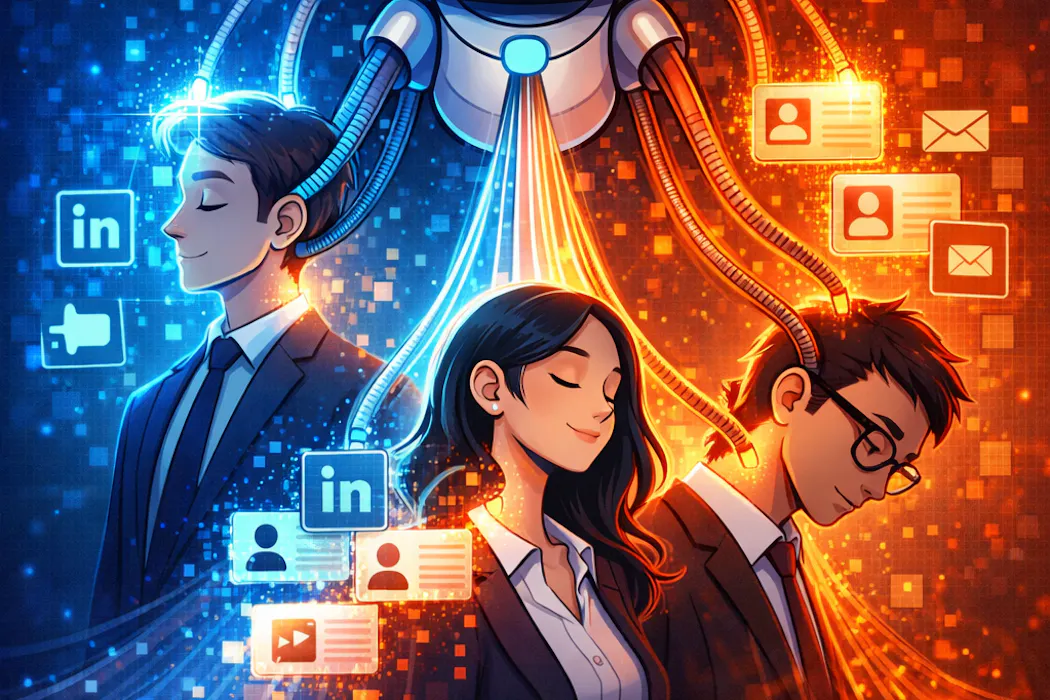
Used in a professional context, AI is often perceived as a mere tool. However, its use can impact the way individuals construct their identity at work. Young professionals are particularly exposed and could eventually encounter difficulties recognizing who they truly are.
Your resume is written by ChatGPT. Your LinkedIn profile, refined by an algorithm. Your professional emails are corrected in real time. The consequences of using artificial intelligence (AI) in a professional setting are not limited to saving time and increasing efficiency. It is your professional identity that is being redefined. Silently. Deeply.
It would be better if it were not without your knowledge.
To be or not to be authentic
Imagine two candidates for the same position. One has written their cover letter by hand, laboriously, with their own words. The other has used a generative AI assistant to structure, refine, and polish their speech in a few minutes. Which one is more competent? Which one is more authentic? And above all, which one is truly themselves?
These questions are emerging today at the heart of the labor market. Increasingly, they will be at the center of the professional world.
Also to read:
Employees, business leaders: AI is going to change everything, take advantage of it!
“Generative artificial intelligence (generative AI) is a category of AI that focuses on the independent creation of data, content, or artistic things. It differs from classical AI, which focuses on specific tasks such as classification, prediction, or problem-solving. Generative AI aims to produce new data that resembles those created by human beings, whether in the form of texts, images, or music, for example.”
indicates aarticle published byBig media.
The rapid rise of generative AI tools (Lechat, ChatGPT, Copilot, Claude…) is transforming not only the way we work, but also the way we present ourselves, evaluate our skills, and build our professional identity.
This is what a qualitative study conducted with work-study students and active professionals in various sectors reveals. Through twenty-five in-depth interviews, a dual tension emerged with remarkable frequency: AI as a lever for professionalization… and AI as a source of self-questioning.
Who is speaking?
Professional identity is not a given fact. It is built through interactions, recognitions, and accumulated successes. Since the foundational worksby the sociologist Claude Dubar, it is known that identity at work results from a permanent transaction between what one thinks one is and what others recognize in you.
However, AI disrupts this transaction. When a machine formulates an argument on your behalf that you wouldn’t have found on your own, what remains of your real contribution? What does it say about you that you knew how to ask the question well?
When an algorithm optimizes your LinkedIn profile to maximize its visibility, is it still you who is speaking?
Several professionals interviewed as part of our study express this discomfort with striking acuity. The boundary between assistance and substitution becomes blurred, and with it, the boundary between real competence and simulated competence.
“When I use AI, I feel like my work isn’t honest, that it’s not really me who did it. Giving everything to a tool calls into question my own abilities and the value I attribute to my investment.”
Student in work-study in the financial sector.
A strong identity tension
This testimony is not isolated. It reveals a deep identity tension between the “for oneself” identity – based on effort, expertise, personal investment – and the “for others” identity, that is, the image projected towards recruiters, colleagues, clients. AI can take care of the latter while weakening the former.
This weakening is all the more insidious because it operates quietly. It is not an objectively measurable loss of skill, but a shaking of confidence in one’s own worth. What psychologists call“sense of personal efficacy”, theorized by Albert Bandura, is put to a severe test.
This phenomenon now has a name in the management sciences literature:the “threat of professional identity” (Threat to Professional Identity)
An international study published in 2025 in themagazineAI & Societyconfirms that the more a professional perceives AI as a threat to their identity, the less likely they are to adopt it. However, the article also shows that the professionals who most need to master AI to protect their position are precisely those who resist adopting it the most. This creates a paradox that is both productive and identity-related.
Personal effectiveness, a belief rooted in experience
The sense of personal efficacy refers to an individual’s belief in their ability to perform given tasks. It is not self-esteem in general but a specific belief, rooted in experience: “I am capable of doing this work, even when it is difficult.”
However, the repeated use of AI can gradually erode this conviction. Several participants in our study describe a phenomenon of progressive, almost invisible dependency. One starts by verifying an email with AI. Then one no longer knows how to send an email without it.
“Even though I am confident, I still have this automatic reflex to go and verify. And that creates a loss of confidence. I wonder how I used to manage without AI before?”
Apprenticeship student at a recruitment firm specializing in healthcare.
More or less skills
This testimony illustrates a major paradox. Designed to enhance human capabilities, AI canin fineto weaken them psychologically. Not because the individual actually loses their skills, but because they stop believing in them independently of the tool.
This shift is particularly concerning for young professionals in the process of identity formation. They have not yet accumulated enough foundational experiences to build their confidence on a solid foundation. AI therefore risks bypassing this learning process through trial and error and self-improvement, which is essential for the development of professional identity.
The article by Nir Eisikovits and Jacob Burley published inThe Conversation, already mentioned the ethical questions raised by the use of AI in the context of higher education student learning. Their reflection highlights the phenomenon of “cognitive offloading” at the heart of the disruption of the knowledge acquisition process.
On the other hand, among experienced professionals, the equation seems different. Armed with a sense of efficacy consolidated by years of practice, they use AI as an amplifier, not as a crutch. It “professionalizes,” “structures,” “puts more accurate words” — without calling into question their conviction that they are the true authors of the work produced.
Sell out or betray oneself?
Thepersonal brandingor personal brand, refers to the strategy by which an individual builds and broadcasts a coherent professional image to differentiate themselves in the job market. LinkedIn is its main arena, but it extends to everything that builds the employee’s reputation, including their publications, interventions, and other recommendations.
AI is profoundly transforming the rules of this game. It enables the production of “contentspolished“Optimized profiles, flawless CVs, regardless of the individual’s actual level. It democratizes surface quality while risking to raise the bar on an already fierce competition.
A sign of fragility
One of the most striking lessons from this research is perhaps the following: far from inventing identity frailties, AI acts as a revealer. When a student feels that their work “is not really them” when using AI, it is often a sign that their professional identity is not yet sufficiently anchored to resist technological intermediation.
On the other hand, those who have a solid professional identity, built on lived experiences, recognized achievements, and a coherent trajectory, integrate AI without getting lost. They describe it as “an improved version of themselves,” not as a substitute.
This observation has significant implications for institutions of higher education. Training students in AI cannot be limited to teaching them tools. It is necessary to help them build, above all, a professional identity robust enough so that AI remains an asset and does not become a crutch.
Learning to build an identity
Developing this identity requires working on reflexivity: the ability to observe one’s own actions, to recognize what truly comes from oneself and what is projected onto a machine. It also involves valuing foundational experiences: failures, complicated negotiations, projects carried through to the end without external support.
For science fiction fans and others, the question is not so much whether AI will “take” jobs. It is much more subtle and urgent: will AI vampirize individuals’ professional identities?
This article is based on a qualitative study conducted between December 2025 and January 2026, relying on 25 in-depth semi-structured interviews with work-study students and active professionals (insurance, finance, commerce, law, management, technology). The authors thank Yaël Salomon, a student at Inseec Grande École, for her contribution to the collection and transcription of the empirical data underpinning this study..

Claudia-Roxana RUSU is a member of the IRGO research laboratory at the University of Bordeaux.
Demba Ousmane DIOUF and Youssef Souak do not work for, do not advise, do not own shares in, and do not receive funds from any organization that could benefit from this article, and have declared no affiliation other than their university position.
–ref. When AI betrays professional identities –https://theconversation.com/when-ai-betrays-professional-identities-277639